...

February 15, 2026

Electric Scooters VS Electric Bikes: Which One Should You Choose?

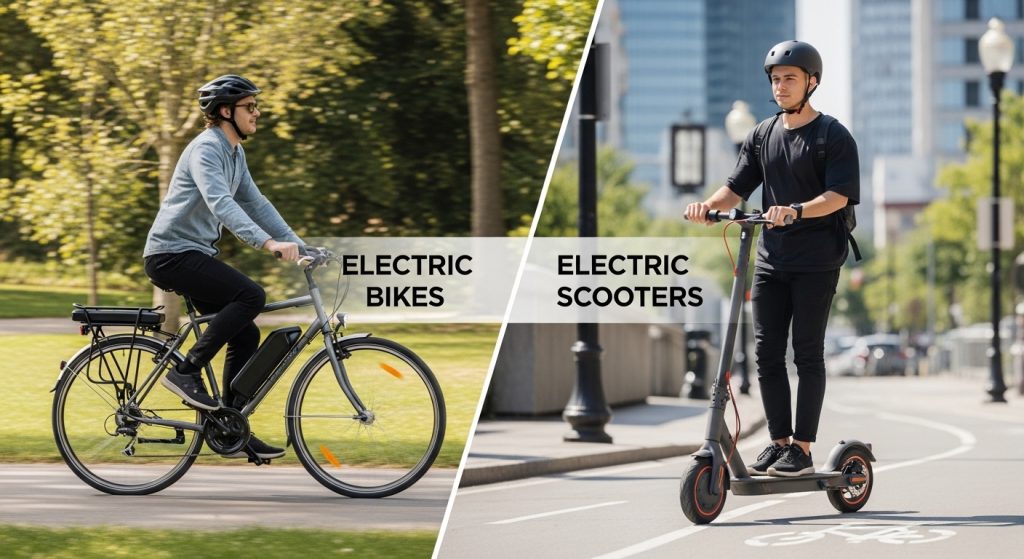
The choice between electric bikes and scooters depends entirely on your specific commuting distance and storage needs. Every morning, you face the same grueling reality of gridlocked traffic and rising fuel costs. This frustration drains your productivity before you even reach the office. Fortunately, choosing between Electric Scooters vs Electric Bikes offers a sustainable solution to reclaim your time. Which wins on portability: Electric Scooters vs Electric Bikes? Electric scooters are the clear winner for users who need to integrate their ride with public transit. When evaluating Electric Scooters vs Electric Bikes, weight is the primary factor for urban professionals. Most scooters weigh between 20 and 50 pounds, making them manageable for stairs. Can they fold for storage? The ability to tuck your ride under a desk is a major operational advantage. While nearly all scooters fold into a compact shape, only specialized bike models offer folding frames. You might be wondering:Is it worth the extra bulk? For most apartment dwellers, the space-saving nature of a scooter is the deciding factor in the morning rush. Key Takeaway: Scooters offer superior portability for multi-modal transit and small office storage. Feature Electric Scooter Electric Bike Average Weight 25–50 lbs 45–80 lbs Folding Style Standard/Compact Specialized/Bulky Storage Need Under desk/Closet Bike rack/Garage Portability is the defining characteristic that separates these two micro-mobility categories for the urban commuter. Who goes further in the Electric Scooters vs Electric Bikes race? Electric bikes generally provide a significantly longer range due to larger battery capacities and human-assisted pedaling. Range anxiety is a common concern when comparing Electric Scooters vs Electric Bikes. While scooters typically cover 15 to 30 miles, bikes can easily double that distance. What happens when the battery dies? A dead battery is a minor inconvenience for a bike rider but a major problem for a scooter user. You can still pedal a bike home if the motor shuts off. Here is the kicker:Bikes allow you to stay mobile even when electronic components fail. This reliability makes them the preferred choice for long-distance regional commutes. Key Takeaway: Electric bikes offer better range security and the flexibility to continue riding without power. Performance Metric Electric Scooter Electric Bike Typical Range 15–30 Miles 25–60 Miles Backup Power None Manual Pedaling Efficiency Motor dependent Hybrid (Human + Motor) Battery efficiency and the safety net of pedals give the electric bike a clear edge for high-mileage users. Is riding hard for Electric Scooters vs Electric Bikes? Neither vehicle requires extensive training, but bikes benefit from the muscle memory most people developed in childhood. When looking at Electric Scooters vs Electric Bikes, the learning curve is remarkably shallow for both options. Most riders feel confident within the first ten minutes of operation. How fast can you master a scooter? Scooters offer an intuitive “hop-on, hop-off” experience that simplifies the morning departure. Since you stand close to the ground, balancing feels more natural for those who haven’t cycled in years. But wait, there’s more:The simplicity of the scooter makes it accessible to a wider demographic of users. You don’t need specialized clothing or athletic shoes to feel stable on the platform. Key Takeaway: Scooters are slightly easier to master for non-cyclists, while bikes offer a familiar traditional feel. Ease of Use Electric Scooter Electric Bike Learning Time 5–10 Minutes 10–20 Minutes Mounting Low step-on Leg over/Step-through Operation Throttle only Throttle + Pedaling The low barrier to entry for both vehicles ensures that you can start commuting immediately without a steep training phase. Which offers a smoother Electric Scooters vs Electric Bikes ride? Electric bikes provide a much smoother ride over rough terrain due to their significantly larger wheel diameters. Stability is a major point of contention in the Electric Scooters vs Electric Bikes debate. Larger wheels absorb potholes and cracks that might cause a scooter to wobble. Sitting vs standing: which is better? Comfort during long rides often comes down to the riding position and ergonomic design. Sitting on a saddle reduces leg fatigue, which is vital for trips exceeding three miles. Here is the kicker:Larger wheels act as natural shock absorbers for the spine. If your route includes cobblestones or uneven pavement, the bike’s stability is a non-negotiable safety feature. Key Takeaway: Larger wheels and a seated position make electric bikes the superior choice for comfort and stability. Comfort Feature Electric Scooter Electric Bike Wheel Size 8–11 Inches 20–29 Inches Riding Posture Standing Seated Rough Terrain Moderate vibrations High vibration damping Ride quality is heavily influenced by wheel physics, favoring the bicycle for any route that isn’t perfectly paved. Can you carry gear with Electric Scooters vs Electric Bikes? Bikes are designed for utility and can be outfitted with racks to carry significant cargo. When comparing Electric Scooters vs Electric Bikes, you must consider your daily payload needs. Most scooters require the rider to carry everything in a backpack. Can you fit groceries on a bike? Bicycles can easily handle panniers, baskets, and even child seats, making them versatile for errands. This transformation from a simple commuter to a cargo vehicle is a key selling point for many professionals. You might be wondering:What about scooter accessories? While you can add small handlebar bags, they often affect steering balance and overall safety. Key Takeaway: Electric bikes are the undisputed leaders for carrying groceries, work gear, or heavy laptops. Cargo Utility Electric Scooter Electric Bike Storage Options Backpack only Racks, Baskets, Panniers Weight Capacity Low/Rider only High/Cargo support Versatility Commute focused Multi-tasking utility For those who need to replace car trips entirely, the cargo capacity of an e-bike is a critical functional requirement. Which is more affordable: Electric Scooters vs Electric Bikes? Electric scooters generally offer a much lower entry-level price point for the budget-conscious professional. The financial barrier between Electric Scooters vs Electric Bikes can be several hundred dollars. High-quality commuter scooters often start around half the price of a mid-range electric bike. Which provides better long-term value? While scooters are cheaper upfront, bikes often benefit from standardized parts that

Electric Scooters VS Electric Bikes: Which One Should You Choose? Read More »
Understanding Regenerative Braking in Electric Scooters

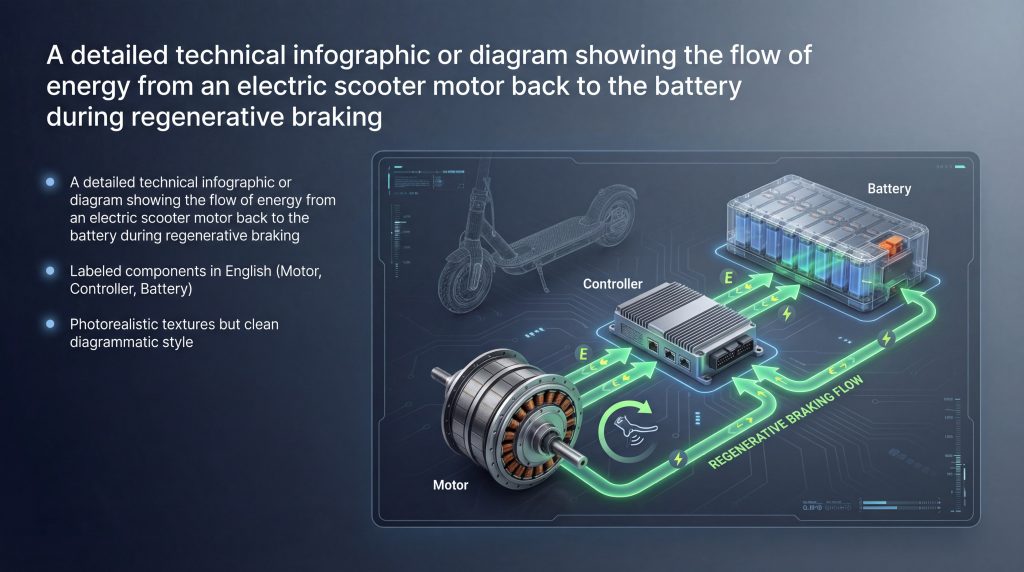
Regenerative braking is an energy recovery mechanism that slows a vehicle by converting its kinetic energy into a form that can be either used immediately or stored in a battery. If you are a daily commuter, you likely struggle with range anxiety and the constant need to find a charging outlet. Standard friction brakes waste massive amounts of energy as heat, effectively throwing away the momentum you worked so hard to build. By utilizing regenerative braking in electric scooter technology, you can recapture that lost energy and turn every stop into a mini-charge for your ride. 1. What Is Regenerative Braking in Electric Scooters? Regenerative braking in electric scooters refers to the process where the electric motor acts as a generator to recharge the battery during deceleration. This system captures the kinetic energy of your moving scooter and directs it back into the power cell rather than letting it dissipate. Integrating regenerative braking in electric scooter models represents a major leap in personal transport efficiency. It ensures that your hardware works for you even when you are slowing down. The Transition From Mechanical to Electronic Braking The shift toward electronic braking systems marks a significant evolution in how you control your speed on the road. Traditional systems rely solely on friction, but modern scooters use magnets to create drag. Here is the deal: switching to electronic braking doesn’t just save energy; it changes the entire feel of your ride. The Evolution of Energy Recovery in Personal EVs Personal electric vehicles have come a long way from simple motorized frames to high-tech commuting tools. Energy recovery used to be reserved for high-end electric cars, but it is now accessible for your daily commute. But that’s not all. This evolution means you get a smarter, more responsive vehicle that understands how to manage its own power reserves. Key Takeaways: Feature Mechanical Braking Regenerative Braking Primary Method Physical Friction Electromagnetic Induction Energy Impact Lost as Heat Recovered to Battery Components Pads, Discs, Cables Motor, Controller, Battery Analysis: While mechanical brakes provide raw stopping power, regenerative systems offer a sustainable way to manage momentum and energy efficiency. 2. How Does the Motor Generate Electricity While Braking? The motor generates electricity by utilizing electromagnetic induction to convert the spinning motion of the wheels back into electrical current. When you stop applying power, the wheel continues to spin the motor’s internal components through magnetic fields. This creates a flow of electrons that the controller directs back to your power supply. Implementing regenerative braking in electric scooter designs relies on this fundamental principle of physics. Understanding the Dual Role of Brushless DC Motors Your scooter’s brushless DC (BLDC) motor is a versatile piece of engineering that works in two directions. In drive mode, it consumes electricity to move you; in braking mode, it produces it. Think about it: your motor is essentially a power plant that you carry between your wheels. The Science of Stators, Rotors, and Magnetic Fields The interaction between the stationary part of the motor (stator) and the rotating part (rotor) is where the magic happens. As the rotor spins past the stator’s coils, it “pushes” electrons through the wire. But wait, there’s more. The strength of this magnetic field can be adjusted by the controller to provide more or less braking force. Key Takeaways: Component Function During Propulsion Function During Braking Battery Supplies electrical energy Receives recovered energy Controller Directs power to the motor Routes current to the battery Motor (BLDC) Converts electricity to motion Acts as a generator Analysis: The seamless transition between consuming and generating power is the technical foundation that allows for extended range and smoother deceleration. 3. What Happens When You Engage the Regenerative Brake? Engaging the brake sends a digital signal to the controller to reverse the phase of the motor, creating resistance that slows the scooter. This happens the moment you pull the lever or release the throttle, depending on your scooter’s settings. The motor effectively becomes a “drag” on the wheel, converting your forward speed into electrical energy. Understanding the activation of regenerative braking in electric scooter systems helps you anticipate how your vehicle will respond. Converting Kinetic Energy into Battery Power As you slow down, the energy of your movement has to go somewhere. Instead of wearing down your brake pads, that energy travels through the wires back to your battery pack. You might be wondering: does this happen every time I slow down? In most modern configurations, yes, the system is designed to be as proactive as possible. Creating Motor Resistance to Slow Your Momentum The resistance you feel when the electronic brake is active is the result of the motor fighting against its own magnets. This force provides a smooth, predictable deceleration that feels different from a mechanical “bite.” Here’s the kicker: this resistance is entirely frictionless, meaning there are no parts rubbing together to wear out. Key Takeaways: Step Action Outcome 1 Release throttle or pull lever Signal sent to the controller 2 Power supply cut Motor ceases propulsion mode 3 Induction begins Spinning wheel generates current 4 Energy storage Current is sent to the battery Analysis: By translating motion into magnetism, the system creates a controlled deceleration that benefits both the rider’s control and the vehicle’s battery life. 4. Can It Actually Increase Your Scooter’s Travel Range? Regenerative braking can increase your travel range by reclaiming energy that would otherwise be lost as heat through mechanical friction. While it won’t give you an infinite ride, it can add precious percentage points back to your battery during a long commute. This is especially true if your route involves many hills or frequent stop-and-go traffic. Optimizing regenerative braking in electric scooter use is one of the easiest ways to get more miles out of a single charge. Managing Expectations for Energy Recovery Efficiency It is important to understand that no system is 100% efficient due to the laws of thermodynamics. You will only recover a fraction of the total energy used to

Understanding Regenerative Braking in Electric Scooters Read More »

Do Police Pull Over Electric Scooter Riders? Reasons, Laws & What to Expect

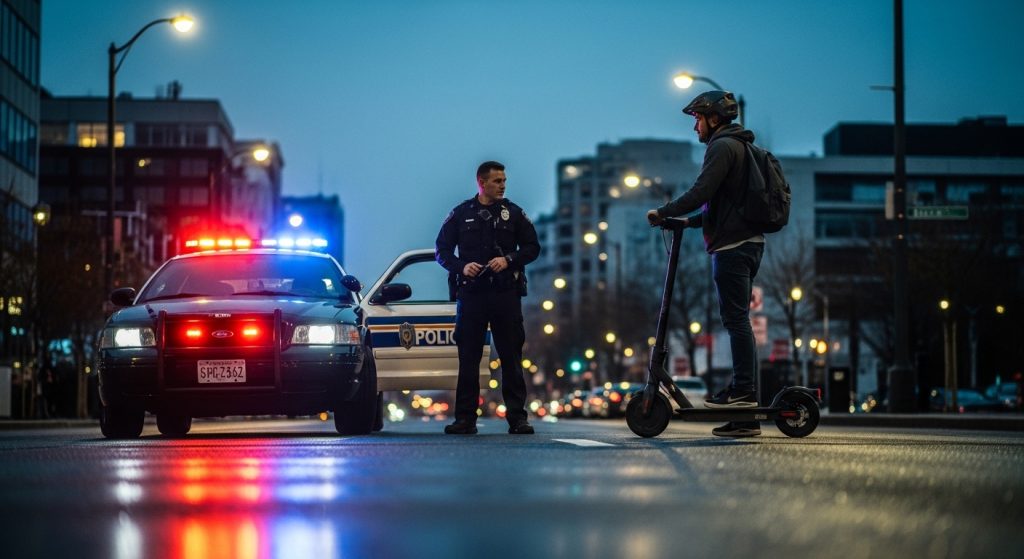
Electric scooters have become a common sight on city streets, offering a convenient and eco-friendly way to commute. But as their popularity has grown, so has the attention from law enforcement. Many new riders wonder if they can be pulled over by police while riding their electric scooter, and the answer is a definite yes. Understanding why you might be stopped, what your rights are, and how to avoid common violations is essential for any responsible rider. Yes, police can and do pull over electric scooter riders. Common reasons include running red lights, riding on sidewalks where prohibited, speeding, and riding under the influence. The penalties can range from verbal warnings to significant fines, penalty points on your license, and even impoundment of your scooter. Riding responsibly and knowing the local laws is the best way to avoid a stop. Dynamic Scooter encourages all riders to prioritize safety and legal compliance. Want to know more? Here’s the complete guide… 1. Why Would Police Stop an Electric Scooter Rider? Police officers stop electric scooter riders for the same reasons they stop any other road user: to enforce traffic laws and ensure public safety. The most common reason is a traffic violation. This includes running red lights, ignoring stop signs, or failing to yield to pedestrians at crosswalks. These are serious offenses that put both the rider and others at risk. The bottom line is that electric scooters are vehicles, and riders are expected to follow the rules of the road. Another frequent cause for a stop is riding on sidewalks. In many cities, it is illegal to ride an electric scooter on the sidewalk because it poses a danger to pedestrians. If an officer sees you zipping past pedestrians on a busy sidewalk, they have every right to pull you over. Similarly, riding in the wrong direction on a one-way street or against the flow of traffic is a clear violation that will attract police attention. Speeding is also a concern, particularly in areas with designated speed limits for micro-mobility devices. Some cities have zones where electric scooters must travel at reduced speeds, such as near schools or in pedestrian-heavy areas. Exceeding these limits can result in a stop. Finally, riding under the influence of alcohol or drugs is a serious offense that police actively look for, especially late at night. Reason for Stop Description Severity Level Running Red Lights Failing to stop at a red traffic signal. High Sidewalk Riding Riding where pedestrians have right of way. Medium Speeding Exceeding posted speed limits for scooters. Medium DUI/DWI Operating a scooter while intoxicated. Very High No Lights at Night Riding without required lighting after dark. Medium 2. What Are the Most Common Traffic Violations for Scooters? Understanding the most common violations can help you avoid them. At the top of the list is failure to stop at intersections. Many scooter riders, perhaps because they feel less visible or more agile than cars, treat stop signs and red lights as optional. This is not only illegal but extremely dangerous. Intersections are where most collisions occur. Here’s the reality: police are well aware of this behavior and often target intersections for enforcement. Riding against the flow of traffic is another common mistake. Some riders think it is safer to see oncoming traffic, but this is incorrect and illegal. It confuses drivers and makes accidents more likely. You should always ride in the same direction as traffic, using bike lanes where available. Illegal sidewalk riding is also prevalent. While it might feel safer to be away from cars, sidewalks are for pedestrians, and a collision with a walker can cause serious injury. Not yielding to pedestrians is a related issue. Even when you are in a bike lane or on the road, pedestrians crossing the street have the right of way. Failing to stop for them is a violation. Finally, distracted riding, particularly using a phone while riding, is increasingly being targeted by police. Just like with driving, taking your attention off the road is a recipe for disaster. Violation Why It’s Dangerous Typical Fine Range Failure to Stop High risk of collision at intersections. $100 – $250 Wrong-Way Riding Confuses drivers; increases collision risk. $50 – $150 Sidewalk Riding Endangers pedestrians. $50 – $200 Not Yielding to Pedestrians Can cause serious injury to walkers. $75 – $200 Distracted Riding Reduces reaction time; causes accidents. $100 – $300 3. How Do Police Enforce Electric Scooter Laws? Police enforcement of electric scooter laws varies by jurisdiction, but there are common approaches. For minor, first-time infractions, an officer may issue a verbal warning. This is often the case if you are cooperative and the violation was not particularly dangerous. A warning is a chance to correct your behavior without any penalty. Take it seriously: a warning today could be a ticket tomorrow. For clear violations, police will issue a citation, commonly known as a ticket. This is a formal notice that you have broken the law and must pay a fine. The citation will detail the offense, the fine amount, and instructions for payment or contesting the ticket. In more serious cases, such as repeat offenses or reckless riding, police have the authority to impound your electric scooter. Getting your scooter back typically involves paying impound fees and proving ownership. If an officer suspects you are riding under the influence, they can conduct a field sobriety test, just as they would for a motorist. Failing this test can lead to arrest and criminal charges. Some cities also engage in targeted enforcement campaigns in areas with high complaint rates, such as busy downtown areas or near parks. During these campaigns, you are more likely to be stopped even for minor violations. Enforcement Action When It’s Used Consequence for Rider Verbal Warning Minor, first-time infractions. None (educational) Citation (Ticket) Clear violations of traffic law. Fine payment required Scooter Impoundment Serious or repeat offenses. Loss of scooter; fees Sobriety Test Suspected DUI/DWI. Potential arrest Targeted Enforcement High-complaint areas

Do Police Pull Over Electric Scooter Riders? Reasons, Laws & What to Expect Read More »

How To Loosen Up The Clamp For Electric Scooter? Step-by-Step Fix Guide

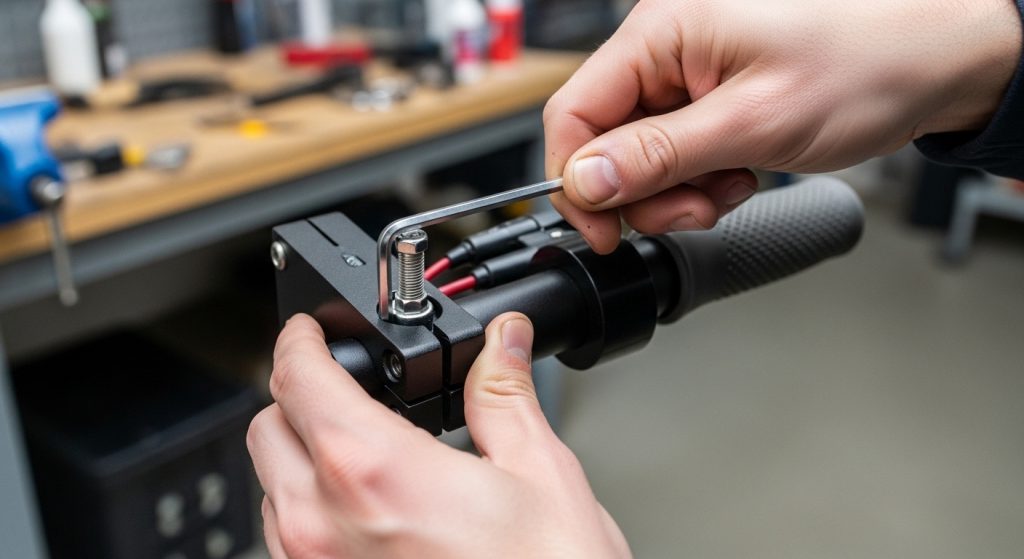
A wobbly handlebar or a folding mechanism that just won’t budge. These are common frustrations for electric scooter owners. Ignoring a clamp issue can lead to dangerous riding conditions or damage your electric scooter. You need a reliable fix, and you need it now. To loosen an electric scooter clamp, you typically need an Allen key or a socket wrench. Locate the main adjustment bolt on the clamp mechanism. Turn the bolt counter-clockwise in small increments, usually a quarter-turn at a time. Test the folding action or stem stability after each adjustment until the desired looseness is achieved. Always check for wobble before riding. So, what are the exact steps for different types of clamps, and what safety checks should you perform? Let me explain… 1. Why Would You Need to Loosen Your Electric Scooter Clamp? Understanding why you need to adjust your electric scooter clamp is the first step to a safe ride. The most common reason is difficulty in folding or unfolding. A clamp that is too tight can make this simple action a real struggle. Another key reason is stem wobble on your electric scooter. If you feel your handlebars shaking or moving while you ride, your clamp is likely too loose. Sometimes a clamp can be so tight that it doesn’t engage properly, which can also cause a wobble. Here’s why it matters… a stable stem is crucial for safe steering. Routine maintenance is another important reason to loosen your electric scooter clamp. Over time, dirt and grime can build up inside the folding mechanism. This can cause it to stick or wear out prematurely. Loosening the clamp allows you to clean these hard-to-reach areas. Finally, you may need to loosen the electric scooter clamp to replace worn-out parts. The clamp is a high-stress component, and parts like the locking latch can wear out. Reason for Loosening Common Symptom Desired Outcome Folding Difficulty Clamp is hard to open or close. Smooth and easy folding action. Stem Wobble Handlebars shake during the ride. A stable and secure steering stem. Maintenance Grinding noise or sticking mechanism. A clean and well-lubricated clamp. Part Replacement A broken latch or stripped bolt. A fully functional and safe clamp. 2. What Tools and Steps Are Needed to Loosen the Clamp? Having the right tools on hand makes any electric scooter maintenance task easier and safer. For loosening a clamp, you don’t need a full mechanic’s workshop. A few basic tools will get the job done. The most common tool you will need is a set of Allen keys, also known as hex wrenches. Most electric scooter clamps use hexagonal bolts. A good set of metric Allen keys (usually sizes 4mm, 5mm, and 6mm) will cover most models. It’s best to use high-quality keys to avoid stripping the bolts. Some clamps may use standard hex bolts or nuts. For these, you will need a socket wrench set. The best part? These tools are useful for many other electric scooter repairs. Once you have located the main adjustment bolt on your electric scooter, select the correct tool. For a hex bolt, use the appropriate size Allen key. Insert the tool firmly into the bolt head. To loosen the clamp, you will turn the bolt counter-clockwise. Make small, incremental adjustments. A quarter-turn at a time is usually enough. After each quarter-turn, test the folding mechanism. Try to open and close the clamp. Is it easier to move? Here’s the deal… patience is key to getting the adjustment just right. Continue this process until the clamp operates smoothly but still locks securely. Tool Primary Use Why It’s Important Allen Keys (Hex Wrenches) Loosening/tightening hexagonal bolts. Most common bolt type on electric scooter clamps. Socket Wrench Set Loosening/tightening standard hex bolts/nuts. Provides a secure grip to prevent slipping. Screwdrivers Removing covers or accessing components. Needed for disassembly on some electric scooter models. Lubricant & Cloths Cleaning and lubricating the mechanism. Essential for smooth operation and longevity. 3. How Do You Adjust Handlebar Clamps and Check for Proper Tightness? Sometimes, the wobble you feel on your electric scooter isn’t from the main folding clamp. It’s from the clamps that hold your handlebars in place. These are usually located at the top of the steering stem. First, locate the bolts that secure the handlebar clamp. There are typically two or four bolts on a handlebar clamp. It is important to loosen them evenly. Use the correct size Allen key and loosen each bolt a little at a time. With the bolts loose, you can now adjust the alignment of your handlebars on your electric scooter. Make sure they are perfectly centered and at the correct angle for your comfort. The handlebars should be perpendicular to the front wheel. Now, you might be wondering… how tight should they be? Once you are happy with the alignment, you can re-tighten the bolts. Again, do this evenly. Tighten each bolt a little at a time, moving in a star or cross pattern. This ensures even pressure across the clamp. The bolts should be snug, but do not overtighten them. Knowing how to spot an improperly adjusted electric scooter clamp is a key safety skill. Let’s start with a clamp that is too tight. The most obvious sign is that it is very difficult to open or close. You may also hear a grinding or creaking sound. A clamp that is too loose is usually easier to spot. The most common sign is a wobbly or unstable handlebar stem. You will feel this as you ride. You may also hear a rattling or clunking noise coming from the folding mechanism. To check for a loose clamp, you can perform a simple physical test. Stand in front and hold the front wheel between your feet. Grab the handlebars and try to move them forward and backward. If you feel any wobble, your clamp is too loose. The bottom line? Any wobble is a safety hazard. Clamp Condition Audible Sign Physical Sign Too Tight

How To Loosen Up The Clamp For Electric Scooter? Step-by-Step Fix Guide Read More »

Shopping Cart
Scroll to Top