
Regenerative braking is an energy recovery mechanism that slows a vehicle by converting its kinetic energy into a form that can be either used immediately or stored in a battery. If you are a daily commuter, you likely struggle with range anxiety and the constant need to find a charging outlet. Standard friction brakes waste massive amounts of energy as heat, effectively throwing away the momentum you worked so hard to build. By utilizing regenerative braking in electric scooter technology, you can recapture that lost energy and turn every stop into a mini-charge for your ride.
1. What Is Regenerative Braking in Electric Scooters?
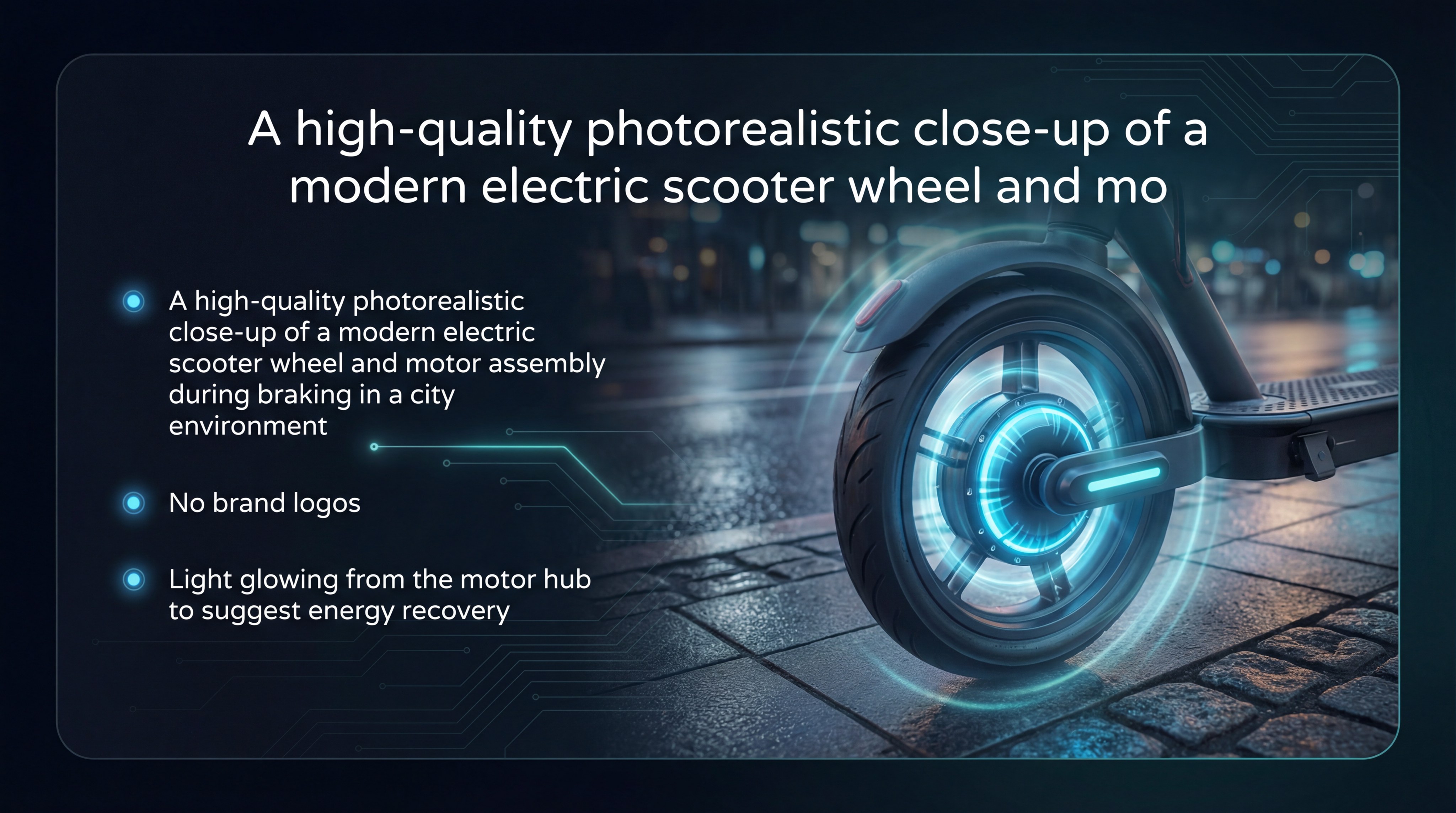
Regenerative braking in electric scooters refers to the process where the electric motor acts as a generator to recharge the battery during deceleration. This system captures the kinetic energy of your moving scooter and directs it back into the power cell rather than letting it dissipate. Integrating regenerative braking in electric scooter models represents a major leap in personal transport efficiency. It ensures that your hardware works for you even when you are slowing down.
The Transition From Mechanical to Electronic Braking
The shift toward electronic braking systems marks a significant evolution in how you control your speed on the road. Traditional systems rely solely on friction, but modern scooters use magnets to create drag.
- Mechanical brakes use pads to grip a disc or drum.
- Electronic systems use the motor’s internal resistance to slow the wheel.
- Hybrid setups combine both for maximum stopping power and efficiency.
Here is the deal: switching to electronic braking doesn’t just save energy; it changes the entire feel of your ride.
The Evolution of Energy Recovery in Personal EVs
Personal electric vehicles have come a long way from simple motorized frames to high-tech commuting tools. Energy recovery used to be reserved for high-end electric cars, but it is now accessible for your daily commute.
- Early scooters lacked the controller sophistication to handle reverse current.
- Modern firmware allows for smooth, variable energy capture.
- The technology is now a standard feature in high-performance models like the Model B.
But that’s not all. This evolution means you get a smarter, more responsive vehicle that understands how to manage its own power reserves.
Key Takeaways:
- Regenerative braking converts kinetic energy back into electrical energy.
- It reduces energy waste typically lost as heat in friction-based systems.
- Most modern scooters now feature this technology as a standard efficiency booster.
| Feature | Mechanical Braking | Regenerative Braking |
|---|---|---|
| Primary Method | Physical Friction | Electromagnetic Induction |
| Energy Impact | Lost as Heat | Recovered to Battery |
| Components | Pads, Discs, Cables | Motor, Controller, Battery |
Analysis: While mechanical brakes provide raw stopping power, regenerative systems offer a sustainable way to manage momentum and energy efficiency.
2. How Does the Motor Generate Electricity While Braking?
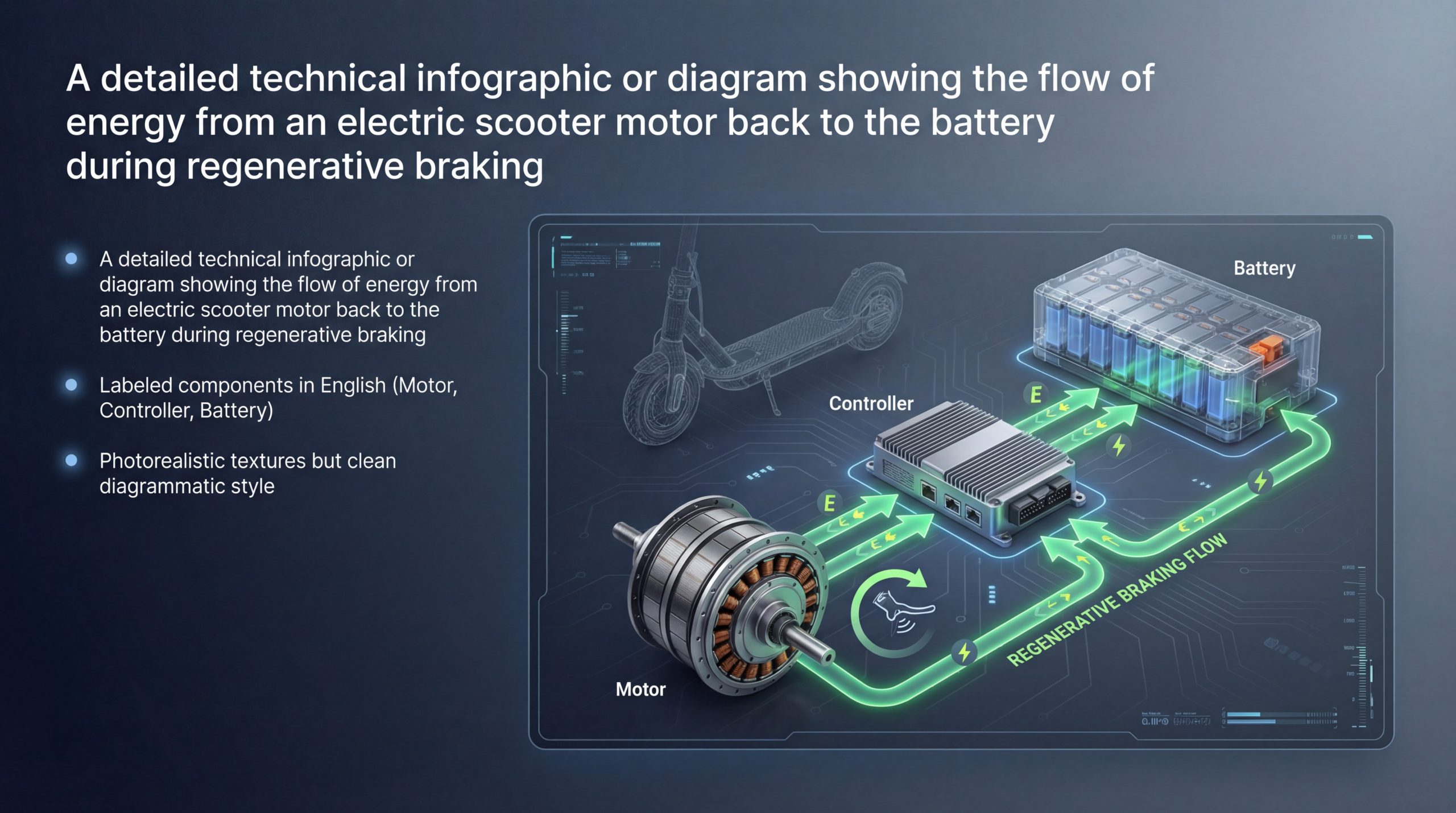
The motor generates electricity by utilizing electromagnetic induction to convert the spinning motion of the wheels back into electrical current. When you stop applying power, the wheel continues to spin the motor’s internal components through magnetic fields. This creates a flow of electrons that the controller directs back to your power supply. Implementing regenerative braking in electric scooter designs relies on this fundamental principle of physics.
Understanding the Dual Role of Brushless DC Motors
Your scooter’s brushless DC (BLDC) motor is a versatile piece of engineering that works in two directions. In drive mode, it consumes electricity to move you; in braking mode, it produces it.
- The motor uses permanent magnets and copper coils.
- Current flow determines if the motor pushes or pulls against motion.
- Sophisticated algorithms manage the switch between these states instantly.
Think about it: your motor is essentially a power plant that you carry between your wheels.
The Science of Stators, Rotors, and Magnetic Fields
The interaction between the stationary part of the motor (stator) and the rotating part (rotor) is where the magic happens. As the rotor spins past the stator’s coils, it “pushes” electrons through the wire.
- Magnetic flux induces a voltage across the motor windings.
- The frequency of the spin determines the amount of energy generated.
- The controller must “rectify” this AC energy into DC for the battery.
But wait, there’s more. The strength of this magnetic field can be adjusted by the controller to provide more or less braking force.
Key Takeaways:
- Motors act as generators by reversing the flow of electromagnetism.
- BLDC motors are uniquely suited for dual-role propulsion and recovery.
- The controller acts as the “brain” that manages the direction of energy.
| Component | Function During Propulsion | Function During Braking |
|---|---|---|
| Battery | Supplies electrical energy | Receives recovered energy |
| Controller | Directs power to the motor | Routes current to the battery |
| Motor (BLDC) | Converts electricity to motion | Acts as a generator |
Analysis: The seamless transition between consuming and generating power is the technical foundation that allows for extended range and smoother deceleration.
3. What Happens When You Engage the Regenerative Brake?
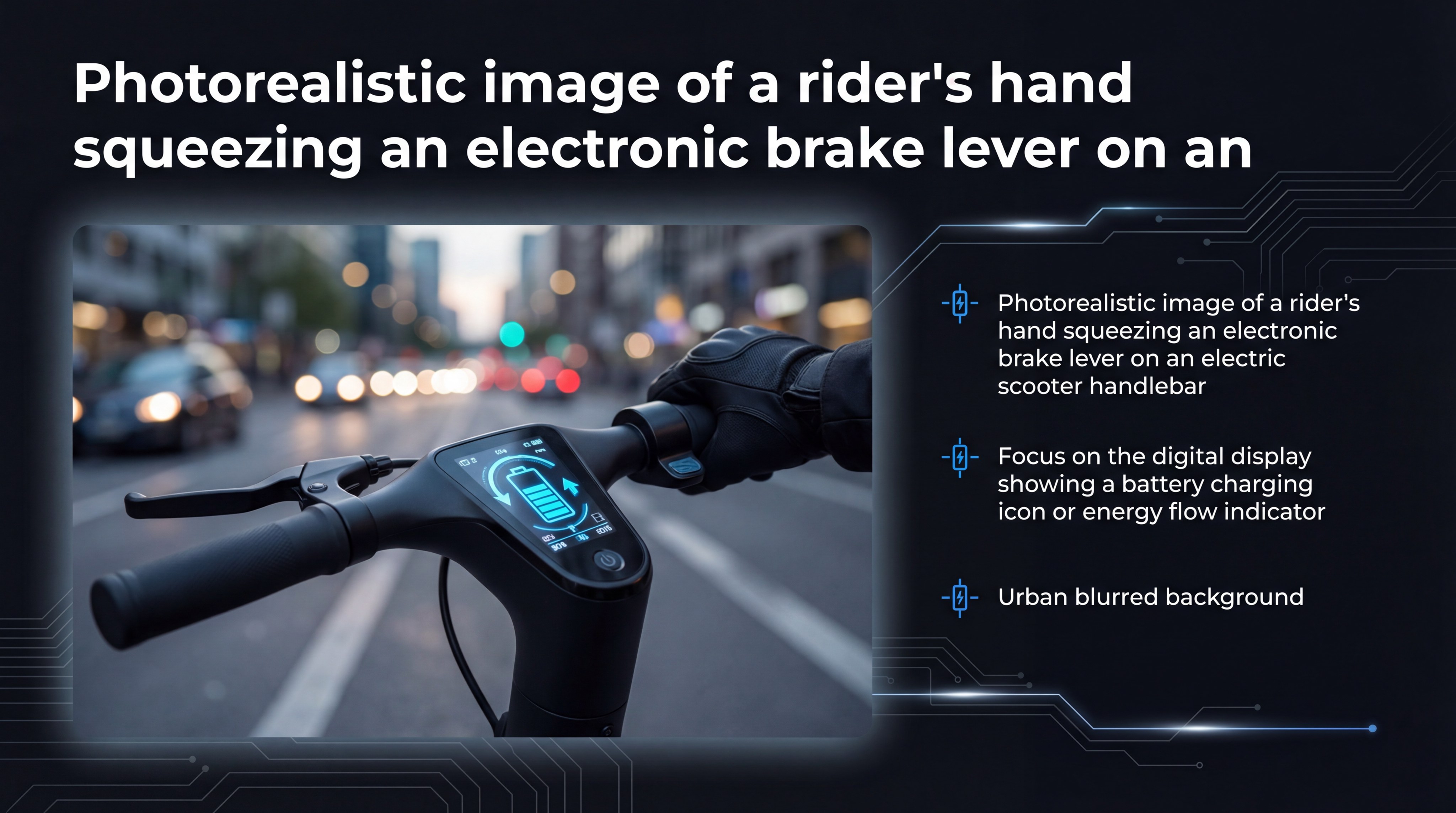
Engaging the brake sends a digital signal to the controller to reverse the phase of the motor, creating resistance that slows the scooter. This happens the moment you pull the lever or release the throttle, depending on your scooter’s settings. The motor effectively becomes a “drag” on the wheel, converting your forward speed into electrical energy. Understanding the activation of regenerative braking in electric scooter systems helps you anticipate how your vehicle will respond.
Converting Kinetic Energy into Battery Power
As you slow down, the energy of your movement has to go somewhere. Instead of wearing down your brake pads, that energy travels through the wires back to your battery pack.
- Sensors detect the change in the brake lever position.
- The controller disconnects the power output.
- Energy begins flowing in the reverse direction immediately.
You might be wondering: does this happen every time I slow down? In most modern configurations, yes, the system is designed to be as proactive as possible.
Creating Motor Resistance to Slow Your Momentum
The resistance you feel when the electronic brake is active is the result of the motor fighting against its own magnets. This force provides a smooth, predictable deceleration that feels different from a mechanical “bite.”
- The controller can vary the intensity of the resistance.
- Higher resistance leads to faster stopping and more energy recovery.
- This drag reduces the need for you to use your physical brake handles.
Here’s the kicker: this resistance is entirely frictionless, meaning there are no parts rubbing together to wear out.
Key Takeaways:
- The process begins with a signal from the brake lever or throttle.
- Energy is routed through the controller to the battery.
- Electromagnetic drag provides the force needed to slow the vehicle.
| Step | Action | Outcome |
|---|---|---|
| 1 | Release throttle or pull lever | Signal sent to the controller |
| 2 | Power supply cut | Motor ceases propulsion mode |
| 3 | Induction begins | Spinning wheel generates current |
| 4 | Energy storage | Current is sent to the battery |
Analysis: By translating motion into magnetism, the system creates a controlled deceleration that benefits both the rider’s control and the vehicle’s battery life.
4. Can It Actually Increase Your Scooter’s Travel Range?
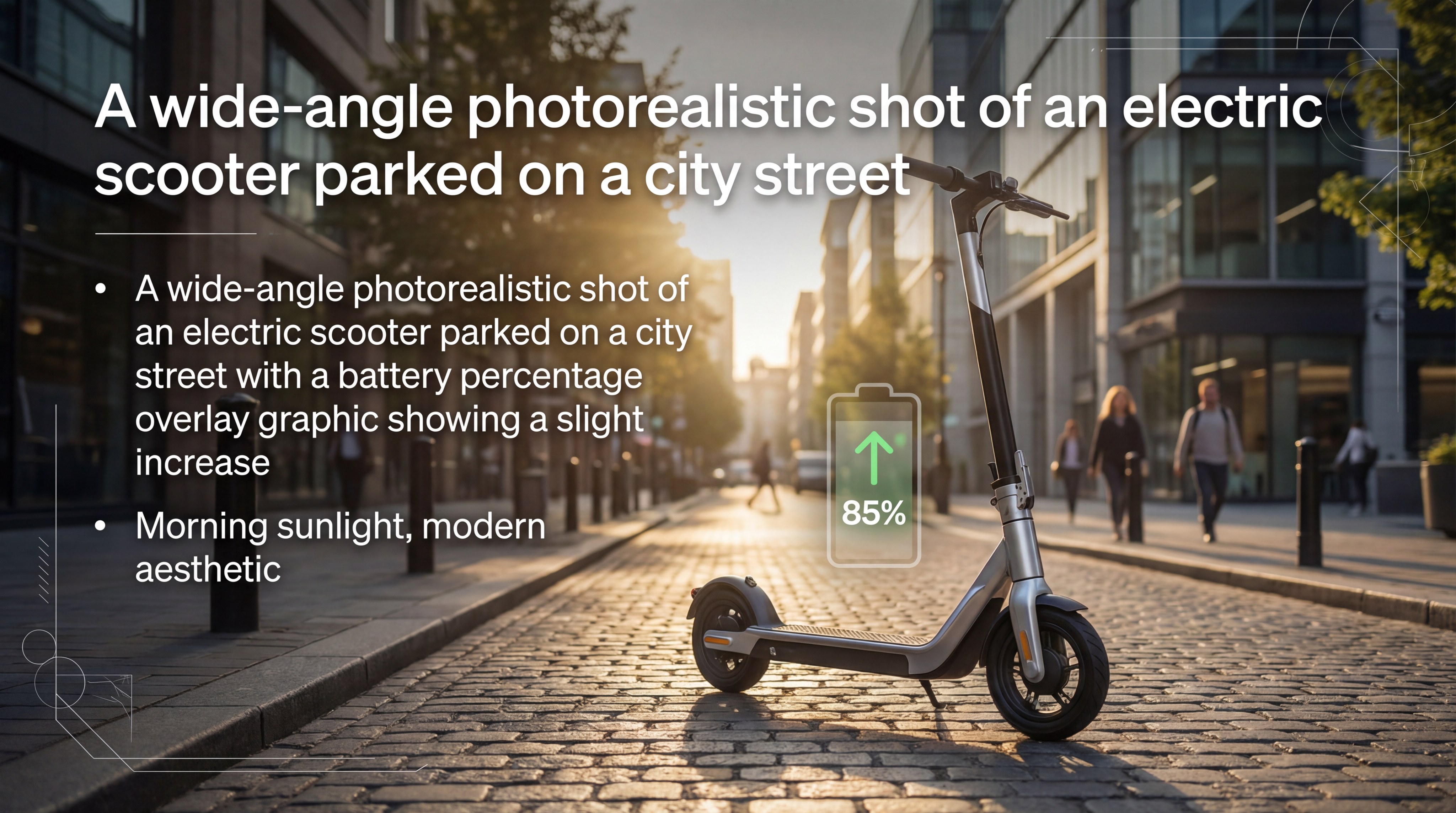
Regenerative braking can increase your travel range by reclaiming energy that would otherwise be lost as heat through mechanical friction. While it won’t give you an infinite ride, it can add precious percentage points back to your battery during a long commute. This is especially true if your route involves many hills or frequent stop-and-go traffic. Optimizing regenerative braking in electric scooter use is one of the easiest ways to get more miles out of a single charge.
Managing Expectations for Energy Recovery Efficiency
It is important to understand that no system is 100% efficient due to the laws of thermodynamics. You will only recover a fraction of the total energy used to accelerate, but every bit helps.
- Typical range gains are between 2% and 5%.
- Heavy stop-and-go riding maximizes these benefits.
- High-speed coasting recovers more energy than slow-speed crawling.
But that’s not all. Even a 3% gain can be the difference between reaching your destination and having to kick-scoot the last few blocks.
Why Small Range Increments Matter for Commuters
For a B2B fleet or a daily professional commuter, efficiency is everything. Small gains in energy recovery lead to fewer charging cycles and a longer overall lifespan for your battery equipment.
- Reduced charging frequency saves time and electricity costs.
- Less strain on the battery cells can improve long-term health.
- Predictable energy recovery makes range estimation more accurate.
Here is the deal: when you multiply these small gains over hundreds of commutes, the value becomes undeniable.
Key Takeaways:
- Range increases are modest but significant for daily users.
- Recovery efficiency depends on riding style and environmental factors.
- Consistent use of the system preserves battery health over time.
| Riding Condition | Potential Energy Recovery | Range Impact |
|---|---|---|
| Flat, steady speed | Minimal | Negligible |
| Urban stop-and-go | High | Significant gain |
| Long descents | Maximum | Highest recovery |
Analysis: While energy recovery isn’t a substitute for a full charge, it provides a crucial efficiency buffer that extends the utility of your electric scooter.
5. What Are the Technical Limits of Energy Recovery?
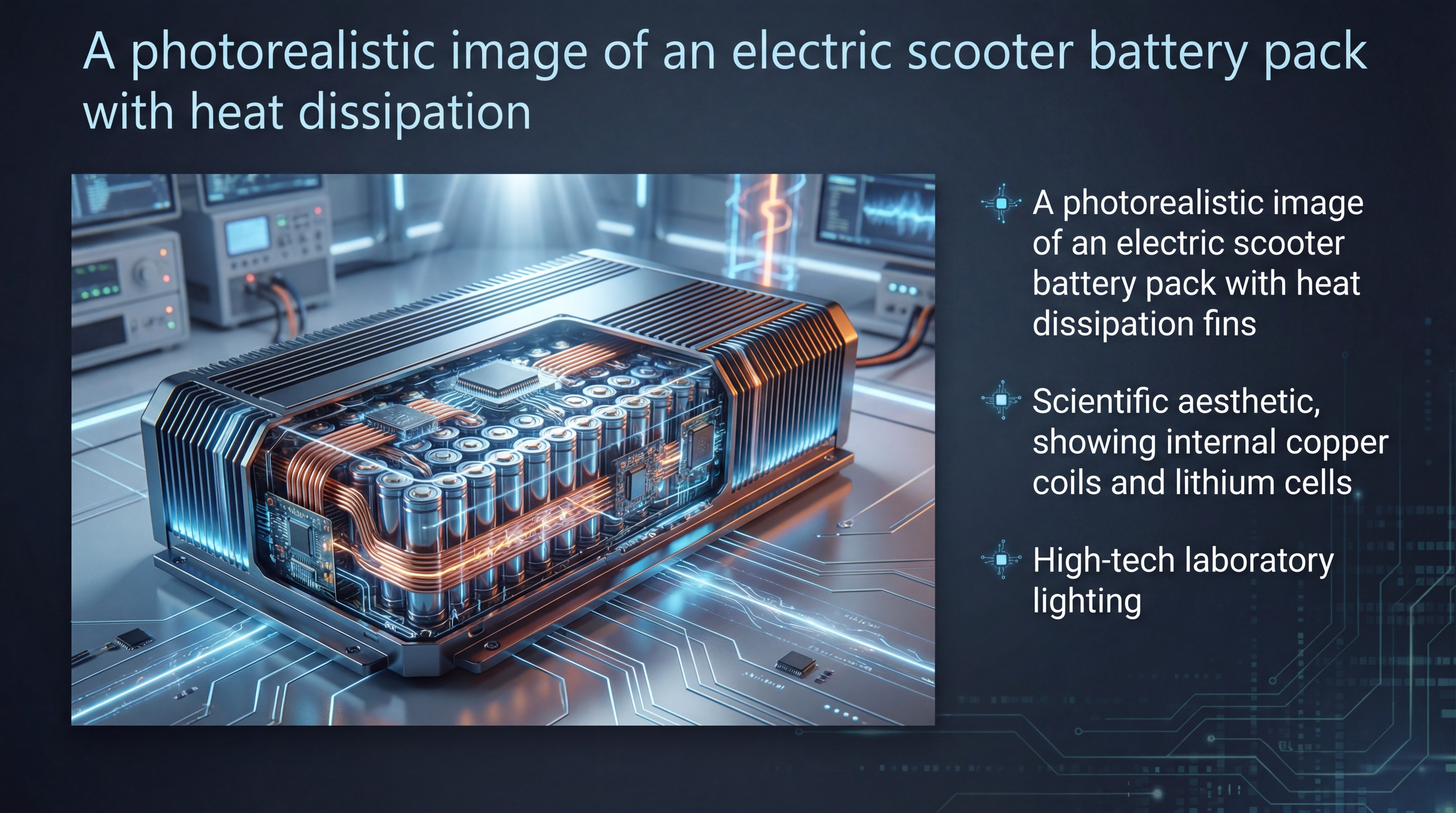
The primary technical limits involve the battery’s charge-absorption rate and the efficiency losses during the conversion of mechanical energy. Batteries cannot be forced to take in energy faster than their chemistry allows without risking permanent damage or overheating. Furthermore, the motor and controller generate their own heat during the conversion process, which accounts for some energy loss. Recognizing the limits of regenerative braking in electric scooter systems helps you ride safer and more effectively.
Why Speed and Weight Dictate Kinetic Energy Potential
The amount of energy available for recovery is directly proportional to how fast you are going and how much you and your scooter weigh. Higher speeds mean more kinetic energy, but also more difficulty in capturing it all at once.
- Kinetic energy increases with the square of your velocity.
- Heavier riders provide more “momentum” for the motor to tap into.
- If you are moving too slowly, the system cannot generate enough voltage to charge the battery.
But wait, there’s more. At very high speeds, the system may actually limit recovery to prevent the motor from spinning too fast as a generator.
The Role of Battery Charging Rates and C-Rates
Every battery pack has a maximum “C-Rate,” which is the speed at which it can safely be charged or discharged. Regenerative braking can sometimes produce a massive spike of energy that exceeds this limit.
- The controller must dump excess energy if the battery is full.
- Rapid charging can lead to internal heat buildup.
- Safety circuits will cut off recovery if the current is too high.
You might be wondering: what happens to that extra energy? Usually, it is simply lost, as the system protects your expensive battery cells first.
Key Takeaways:
- Recovery is physically limited by velocity and mass.
- Batteries have strict limits on how fast they can absorb energy.
- Heat generation during conversion reduces overall efficiency.
| Constraint | Impact | Result |
|---|---|---|
| Low Speed | Insufficient voltage | No energy recovery |
| Full Battery | Safety cut-off | No energy recovery |
| High C-Rate | Excess current | Limited recovery/Heat |
Analysis: Understanding these technical boundaries ensures that you don’t over-rely on electronic braking in situations where it may be automatically limited.
6. Does Temperature Impact Regenerative Braking Performance?
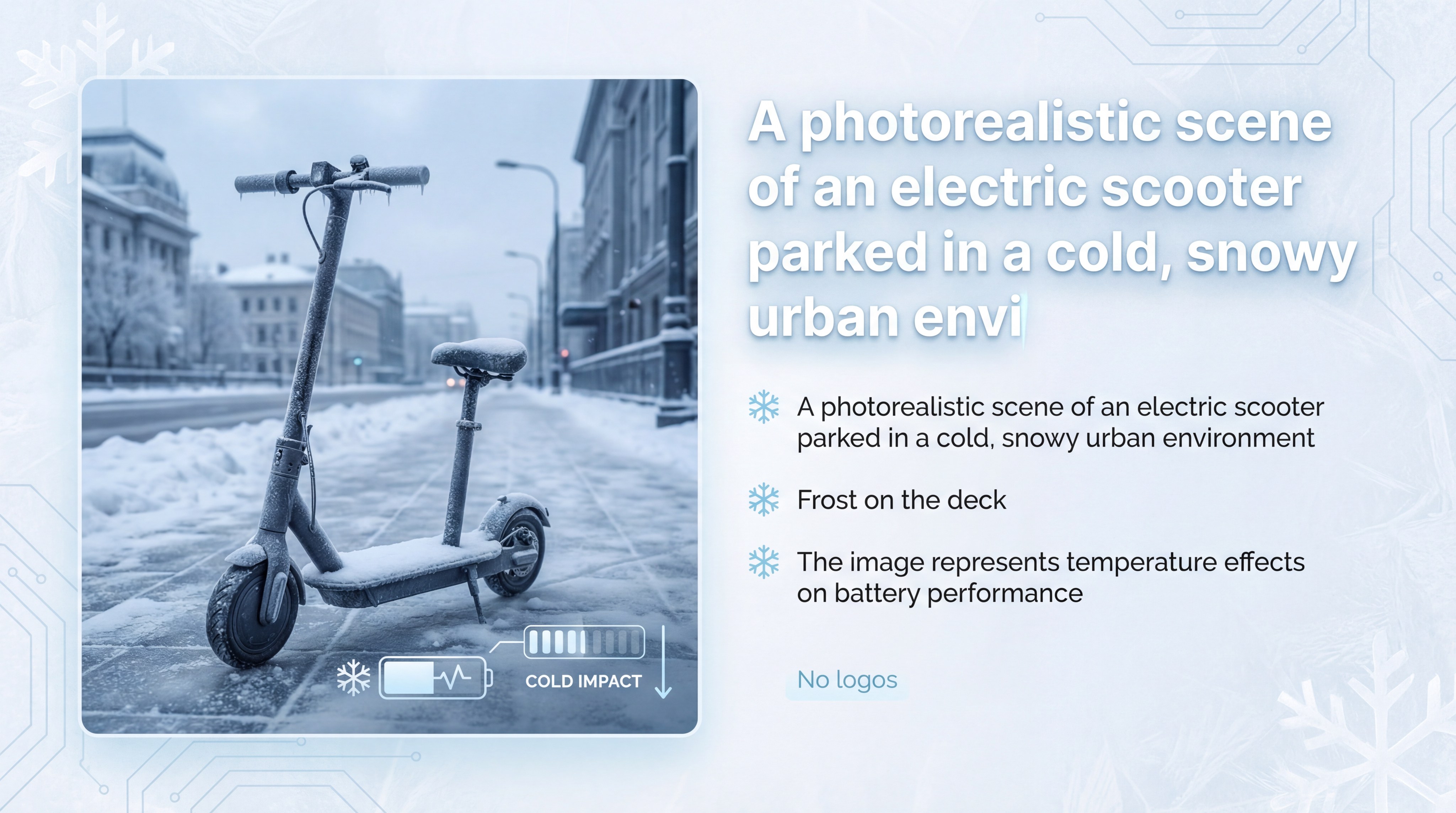
Temperature significantly impacts performance because lithium-ion batteries exhibit higher internal resistance in cold weather, which limits their ability to accept a rapid charge. When the thermometer drops, the chemical reactions inside your battery slow down, making it much harder for the “regen” current to enter the cells. In extreme heat, the system may also throttle recovery to prevent the battery from reaching unsafe thermal levels. Maintaining regenerative braking in electric scooter efficiency requires being mindful of your environment.
Why Cold Weather Sluggishness Affects Battery Absorption
In the winter, you might notice that your electronic brake feels “weaker” or less responsive than usual. This is often not a mechanical failure but a protective measure by your scooter’s battery management system.
- Internal resistance increases as temperatures fall below 10°C (50°F).
- Cold batteries can be damaged by high-current charging.
- The controller will reduce the braking force to protect the cells.
But that’s not all. You may also see your total range drop simply because the battery is less efficient at both giving and taking power.
Managing Heat and High-Voltage Stress During Recharging
While cold is a common enemy, excessive heat can be just as problematic for energy recovery systems during the summer months. The process of generating electricity and pushing it into a battery creates significant thermal stress.
- The motor, controller, and battery all heat up during use.
- Thermal sensors will disable recovery if components get too hot.
- Using accessories and parts with better cooling can help mitigate this.
Here is the deal: if you are riding on a 35°C (95°F) day, your scooter is working harder to stay cool, which may limit your regen potential.
Key Takeaways:
- Cold weather increases resistance and lowers recovery limits.
- Heat can trigger safety shutdowns to prevent component damage.
- Optimal recovery happens in moderate temperatures (15°C to 25°C).
| Temperature Range | Effect on Recovery | Rider Experience |
|---|---|---|
| Below 0°C (32°F) | Severely limited | Very weak braking feel |
| 15°C – 25°C | Optimal | Smooth, strong recovery |
| Above 35°C (95°F) | Throttled | Potential safety cut-offs |
Analysis: Environmental awareness is key to predictable braking, as the system’s effectiveness fluctuates based on the thermal state of the battery.
7. Why Is It Less Effective When the Battery Is Full?
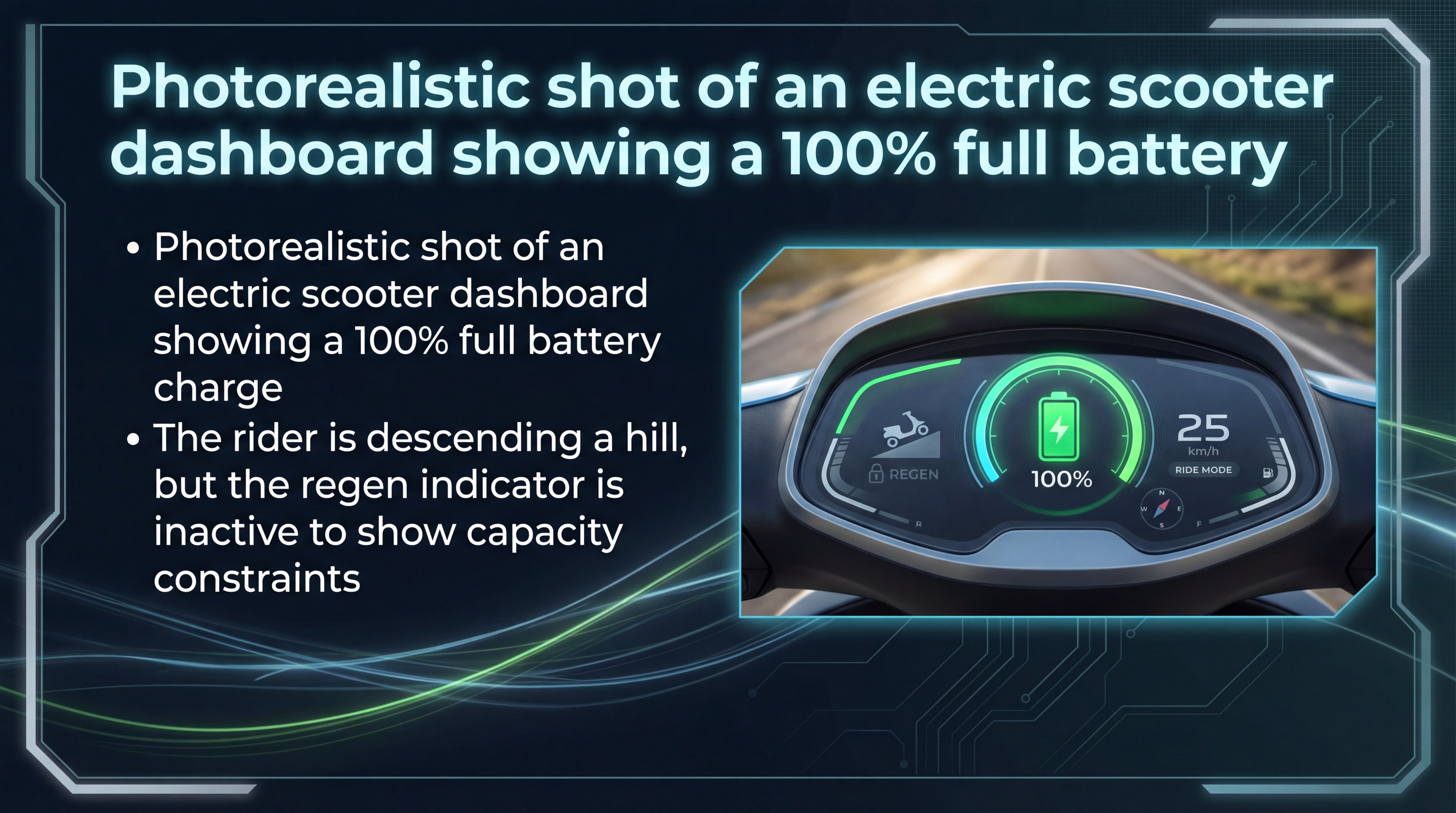
Energy recovery is less effective when the battery is full because the battery management system (BMS) prevents overcharging to ensure safety and longevity. If your battery is already at 100% capacity, there is physically no “room” to store the incoming energy generated by the motor. To protect the cells from catching fire or degrading, the controller will simply stop the flow of electricity. This is a critical safety feature of regenerative braking in electric scooter technology that every rider must understand.
The Capacity Constraints of a Fully Charged Battery
When you start your ride with a full charge, you should expect your electronic brakes to feel almost non-existent for the first mile or two. This “softness” in the lever is the system doing its job to protect your investment.
- A full battery cannot accept more ions without damage.
- Overcharging can lead to “plating” and permanent capacity loss.
- The BMS monitors voltage levels in real-time to prevent this.
Think about it: forcing energy into a full battery is like trying to pour water into a glass that is already overflowing.
Why Hybrid Braking Systems Are Essential for Safety
Because electronic brakes can fail or be disabled when the battery is full, you should never rely on them as your only stopping method. A mechanical backup is essential for those moments when the electronics are offline.
- Disc brakes provide consistent stopping regardless of battery state.
- Hybrid systems automatically blend both types for a seamless feel.
- Having a physical backup is the only way to ensure safety on steep hills.
But wait, there’s more. Modern high-quality scooters are designed so that you don’t even notice the transition between the two systems.
Key Takeaways:
- A 100% charge leaves no room for recovered energy.
- BMS protection will disable electronic braking to prevent overcharging.
- Mechanical brakes are your primary safety net during the start of a ride.
| Battery Level | Regen Availability | Action Needed |
|---|---|---|
| 100% – 95% | None to Low | Use mechanical brakes primarily |
| 94% – 20% | Full | Rely on regen for casual slowing |
| Below 10% | Variable | Monitor dashboard for system limits |
Analysis: Relying on a full charge requires a shift in riding technique, emphasizing the use of mechanical friction until the battery level drops enough to accept recovered energy.
8. What Are the Maintenance Benefits of Electronic Brakes?
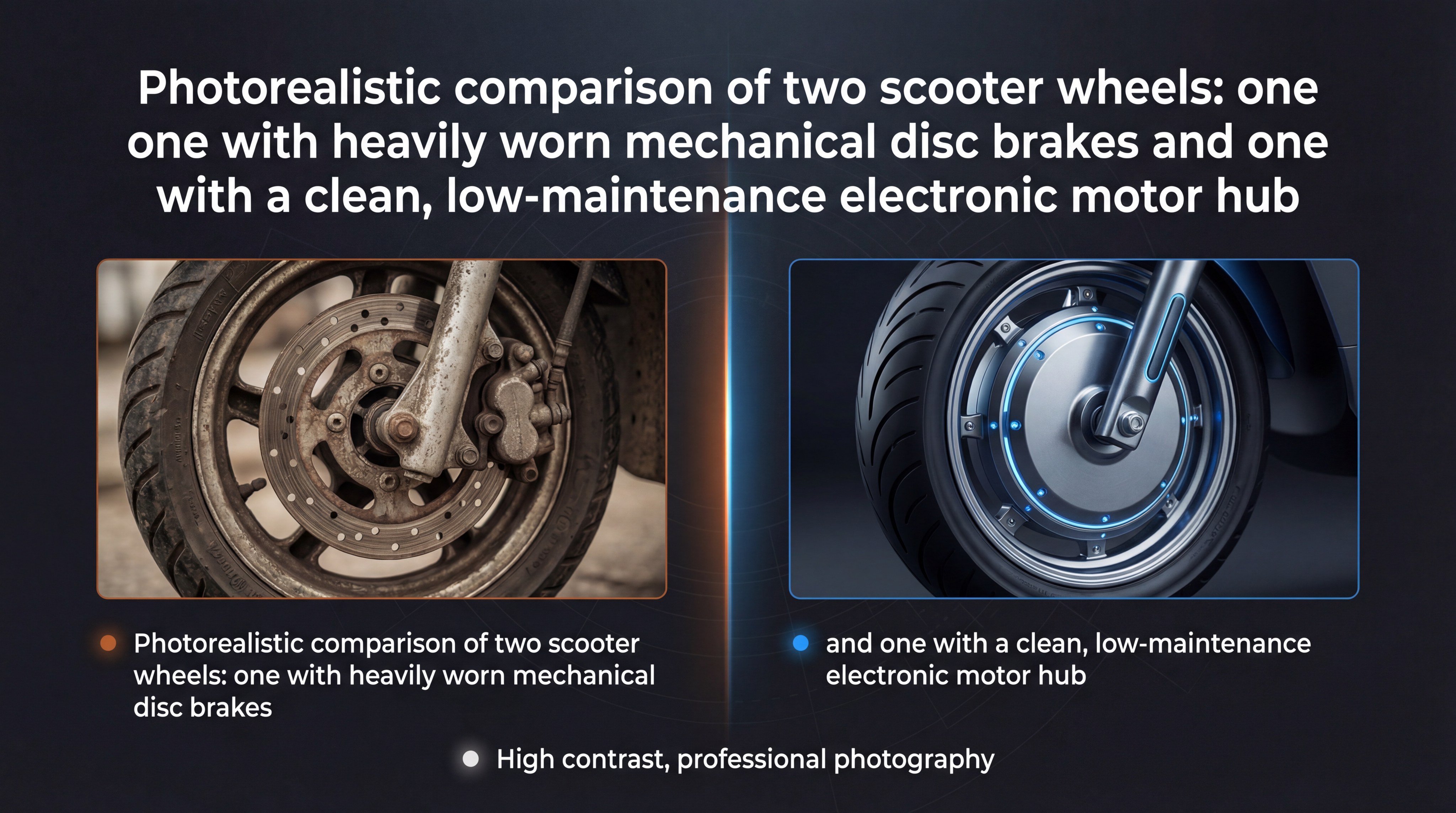
Electronic brakes provide maintenance benefits by reducing the physical wear on mechanical components like brake pads and rotors. Since the motor uses magnets to slow the wheel, there is no physical contact between moving parts during most of your deceleration. This means your expensive mechanical parts will last significantly longer than they would on a traditional bike or scooter. Investing in regenerative braking in electric scooter hardware is a smart long-term move for your wallet.
Reducing the Friction Wear on Pads and Discs
Every time you use a mechanical brake, a tiny layer of the brake pad is ground away to create the friction needed to stop. Over time, these pads become thin and must be replaced to maintain safety.
- Regen handles up to 70% of daily slowing tasks.
- Brake pads stay cooler and last 2-3 times longer.
- Rotors are less likely to warp from extreme heat cycles.
Here is the deal: less friction means fewer trips to the repair shop and more time on the road.
Long-Term Cost Savings for Scooter Owners
For business fleets or daily commuters, the cost of parts and labor can add up quickly. By shifting the braking load to the motor, you are utilizing a component that is designed to last for thousands of miles without service.
- Lower cost of ownership over the life of the vehicle.
- Fewer cable adjustments and hydraulic bleeds required.
- Check our contact page if you need advice on maintaining your hybrid system.
But that’s not all. A cleaner, low-maintenance scooter also holds its resale value much better than one with worn-out hardware.
Key Takeaways:
- Magnets don’t wear out, but brake pads do.
- Electronic braking shifts the workload away from friction parts.
- Owners save money on both replacement parts and professional labor.
| Part | With Regen Braking | Without Regen Braking |
|---|---|---|
| Brake Pads | 12 – 18 months lifespan | 4 – 6 months lifespan |
| Disc Rotors | Rarely replaced | Frequent replacement/warping |
| Maintenance | Low frequency | High frequency |
Analysis: The reduction in mechanical wear is perhaps the most tangible benefit of energy recovery systems, offering a clear return on investment through durability.
9. How Can You Ride More Efficiently Using This System?
You can ride more efficiently by practicing gradual deceleration and anticipating stops to allow the system more time to recover energy. Abrupt, hard braking often forces you to use the mechanical brakes, which wastes the energy you could have captured. By looking ahead at traffic lights and easing off the throttle early, you maximize the motor’s time in generator mode. Mastering the art of regenerative braking in electric scooter operation turns you into a much more sustainable rider.
Mastering Gradual Deceleration and Anticipation
The key to energy recovery is time. The longer you can spend in a state of controlled deceleration, the more energy the motor can push back into the battery cells.
- Look 100 feet ahead to spot red lights early.
- Avoid “sprinting” between stops in city traffic.
- Use the “kick” or “coast” method to maintain momentum.
Here is the deal: smooth riding isn’t just safer; it is the most efficient way to navigate an urban environment.
Leveraging Downhill Momentum for Maximum Gain
Hills are the perfect place to recharge your battery while maintaining a safe speed. Instead of riding your friction brakes all the way down, let the motor do the work for you.
- Gravity provides “free” energy for the motor to capture.
- Electronic braking prevents you from picking up dangerous speeds.
- You arrive at the bottom of the hill with more energy than you had at the top.
But that’s not all. Using regen on descents also prevents your mechanical brakes from overheating and failing when you need them most.
Key Takeaways:
- Smooth, early braking is the secret to maximum energy recovery.
- Anticipating traffic flow reduces the need for “wasteful” friction stops.
- Downhill sections are your best opportunity for significant recharging.
| Strategy | Benefit | Efficiency Impact |
|---|---|---|
| Early Release | Maximizes generator time | High |
| Feathering Lever | Controls resistance levels | Moderate |
| Coasting | Preserves existing momentum | High |
Analysis: Efficiency is a skill that can be developed, transforming the way you interact with your scooter’s energy reserves and improving your overall range.
10. Is Regenerative Braking Safe Enough to Use Alone?
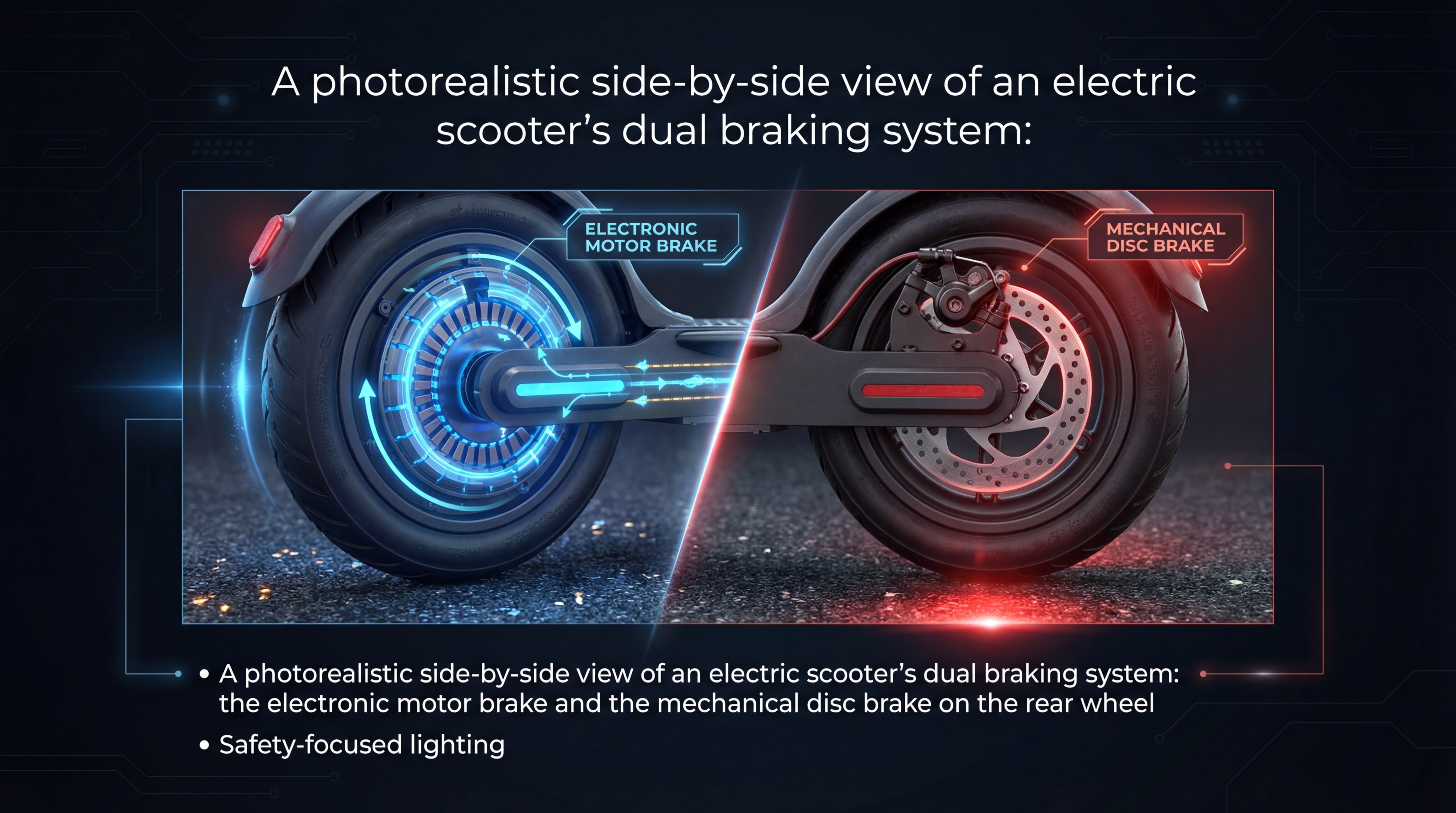
Regenerative braking is generally not safe to use alone because it lacks the immediate stopping power required for emergency situations. While it is excellent for slowing down and managing energy, it cannot lock the wheels or provide the massive friction needed to stop instantly. Most safety regulations require electric scooters to have at least one independent mechanical braking system. When evaluating regenerative braking in electric scooter safety, always consider it as one part of a dual-system approach.
Understanding Braking Distances at High Speeds
At speeds above 15 mph, the distance required to stop using only electronic resistance is significantly longer than using a disc brake. In a city where a car might pull out unexpectedly, those extra feet can be dangerous.
- Electronic brakes have a “ramp-up” time to reach peak force.
- Friction brakes provide instant, high-pressure slowing power.
- The system may cut out if the motor gets too hot or the battery is full.
But that’s not all. If your scooter’s electronics fail for any reason, you would be left with no way to stop without a physical lever.
The Importance of Secondary Friction Brake Systems
The best scooters on the market use a “fail-safe” design where the mechanical and electronic systems work together. This ensures that you have the benefits of energy recovery without sacrificing the ability to stop on a dime.
- Mechanical brakes work even if the battery is dead.
- Dual systems share the heat load, preventing brake fade.
- Learn more about us and our safety-first engineering philosophy.
Think about it: your safety is worth more than a few extra battery percentage points, so always keep your mechanical brakes in top condition.
Key Takeaways:
- Electronic braking is for efficiency; mechanical braking is for emergencies.
- Never ride a scooter that lacks a physical friction brake.
- Combined systems offer the best balance of safety and modern technology.
| Braking Scenario | Recommended System | Reason |
|---|---|---|
| Casual slowing | Regenerative | Save energy and reduce wear |
| Emergency stop | Full Mechanical | Immediate deceleration needed |
| Wet weather | Hybrid / Mechanical | Better grip and predictability |
Analysis: Safety is a non-negotiable priority, and the most effective riding strategy utilizes energy recovery for convenience while reserving mechanical power for protection.
Frequently Asked Questions (FAQ)
- Can I recharge my battery fully using only regenerative braking?
No, the system is designed to recapture a small percentage of energy, usually extending your range by 2% to 5% rather than acting as a primary charger. - What’s the best way to tell if my regenerative brakes are working?
You will feel a smooth, magnetic resistance when you let off the throttle or pull the lever, often accompanied by a faint electrical hum from the motor hub. - Can I disable regenerative braking if I don’t like the feel?
Yes, most modern scooters allow you to adjust the intensity or turn off the system through a dedicated mobile app or the dashboard settings. - What’s the biggest risk of relying only on electronic brakes?
The biggest risk is total failure if your battery is full or your electronics lose power, leaving you with no way to stop your momentum. - Does regenerative braking work better in the rain?
No, it is actually less effective for safety in the rain because it doesn’t provide the same “bite” as mechanical pads on a wet disc.
To learn more about optimizing your ride or to view our latest models, please contact us today.