

Can Two People Safely Ride One Electric Scooter? Laws, Risks & Weight Limits
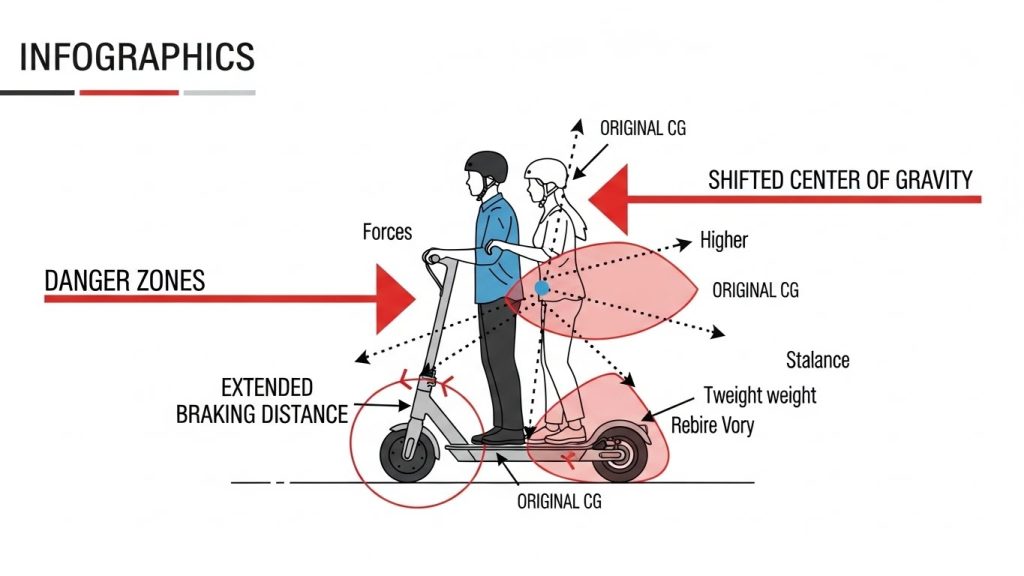
It seems like a fun and efficient way to travel together, but have you ever wondered if it’s actually safe to have two people on a single electric scooter? You see it happen, but the ride often looks wobbly and unsafe, with the scooter struggling under the extra load. An unexpected bump or a sudden need to brake could easily lead to a serious accident, turning a joyful ride into a trip to the emergency room. The scooter’s frame might creak, the brakes could fail, and you could be left with injuries and a broken scooter, all because you tried to share a vehicle designed for one. No, it is not safe for two people to ride an electric scooter. These vehicles are designed and engineered for a single rider. Adding a passenger dangerously compromises the scooter’s balance, braking, and structural integrity, significantly increasing the risk of an accident. It is also illegal in most places and will likely void your warranty. So, what makes it so dangerous, and what should you do instead? Let me explain… This article will break down all the risks, from the physics of instability to the legal and financial consequences, and offer safer alternatives for riding with a friend. 1. Is It Safe for Two People to Ride an Electric Scooter? The short and unequivocal answer is no. Electric scooters are designed with a specific center of gravity and weight capacity, both of which are based on a single rider. When a second person hops on, the entire dynamic of the scooter changes, making it inherently unstable. The platform, or deck, is not long enough to accommodate two people safely, forcing the passenger to stand in an awkward position that throws off the rider’s balance. This makes it incredibly difficult to steer, turn, and react to obstacles. Manufacturers are very clear about this in their user manuals. They explicitly warn against carrying passengers for a reason. The scooter’s braking system is calibrated for a single rider’s weight. With two people on board, the braking distance is significantly increased, meaning you won’t be able to stop in time to avoid a collision. This is important because… the additional weight puts immense stress on the scooter’s frame, motor, and tires, which are not designed to handle such a load. This can lead to a catastrophic failure of a component while you are riding. Ultimately, riding with a passenger is a gamble with your safety and the safety of others. The risk of a fall, a collision, or a mechanical failure is simply too high. It is a classic case of a seemingly harmless shortcut that can have severe consequences. To ensure a safe and enjoyable ride, you must always follow the one-rider-per-scooter rule. Safety Aspect Risk with One Rider Risk with Two Riders Balance Stable and predictable Highly unstable and difficult to control Braking Effective and within specified distance Significantly longer braking distance Structural Integrity Within design limits High risk of frame, motor, or tire failure 2. What Are the Dangers of Overloading an Electric Scooter? Every electric scooter has a maximum weight capacity, which is a critical safety limit set by the manufacturer. This limit is not just a suggestion; it is the maximum load the scooter can safely handle without compromising its structural integrity and performance. When two people ride a scooter, they almost always exceed this weight limit, and that is when things start to get dangerous. The most immediate effect is on the scooter’s frame, which can bend or even snap under the excessive stress. Overloading also puts a severe strain on the motor and the battery. The motor has to work much harder to move the extra weight, which can cause it to overheat and burn out. The battery will drain much faster, drastically reducing your range and putting extra stress on the battery cells, which can shorten their lifespan. Here’s the deal… the tires are also not designed for that much weight. Overloading can cause them to deform, increasing the risk of a blowout, which would be catastrophic at any speed. The most critical danger, however, is the impact on the brakes. The braking system is designed to stop a certain amount of mass. When you double that mass, you dramatically increase the kinetic energy that the brakes need to dissipate. This means your braking distance will be much longer, and in an emergency, you simply will not be able to stop in time. Overloading a scooter is not just a risk to the vehicle; it is a direct threat to your safety. Component Designed Function Consequence of Overloading Frame Support a single rider’s weight Bending, cracking, or complete failure Motor Efficiently power the scooter Overheating, burnout, and reduced lifespan Brakes Stop a single rider safely Increased braking distance, brake failure 3. How Does Riding with a Passenger Affect Scooter Handling? Riding an electric scooter is a delicate dance of balance, and adding a passenger completely disrupts that dance. A scooter is designed to have its center of gravity located directly over the deck, with the rider’s weight distributed evenly. When a second person gets on, the center of gravity shifts backward and upward, making the scooter much more prone to tipping over, especially during acceleration or when going uphill. This shift in balance is the primary reason why handling becomes so difficult. Steering and turning also become a major challenge. To turn a scooter, you need to lean your body into the turn. With a passenger on board, it is nearly impossible for both people to lean in unison. The passenger will often react incorrectly, either by not leaning at all or by leaning in the wrong direction, which can easily cause a loss of control. Want to know the secret? There is no secret; it’s just physics. The scooter is no longer responding to your inputs in a predictable way. This instability is magnified at higher speeds. Any small bump or dip in the road that would […]
Can Two People Safely Ride One Electric Scooter? Laws, Risks & Weight Limits Read More »