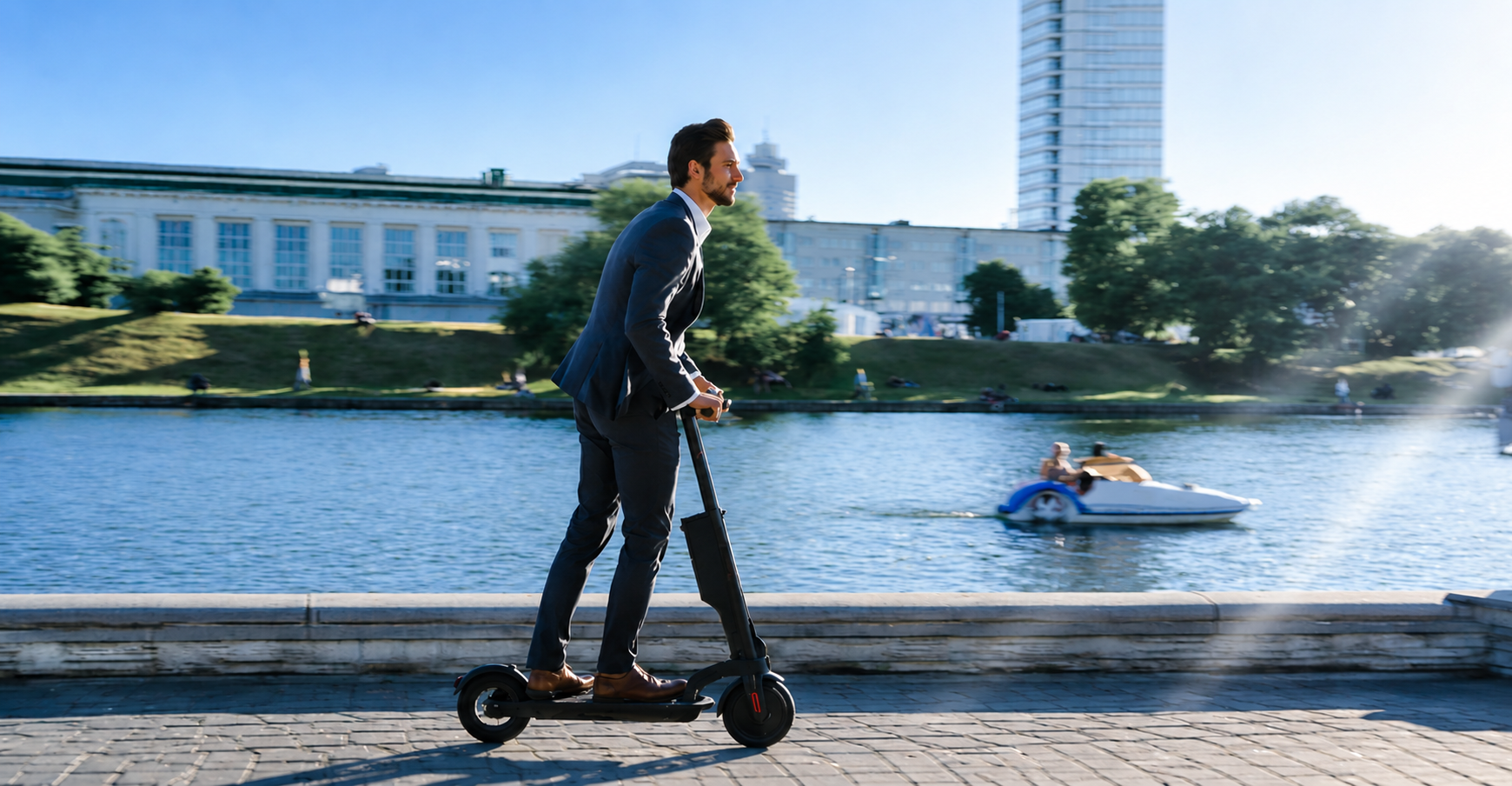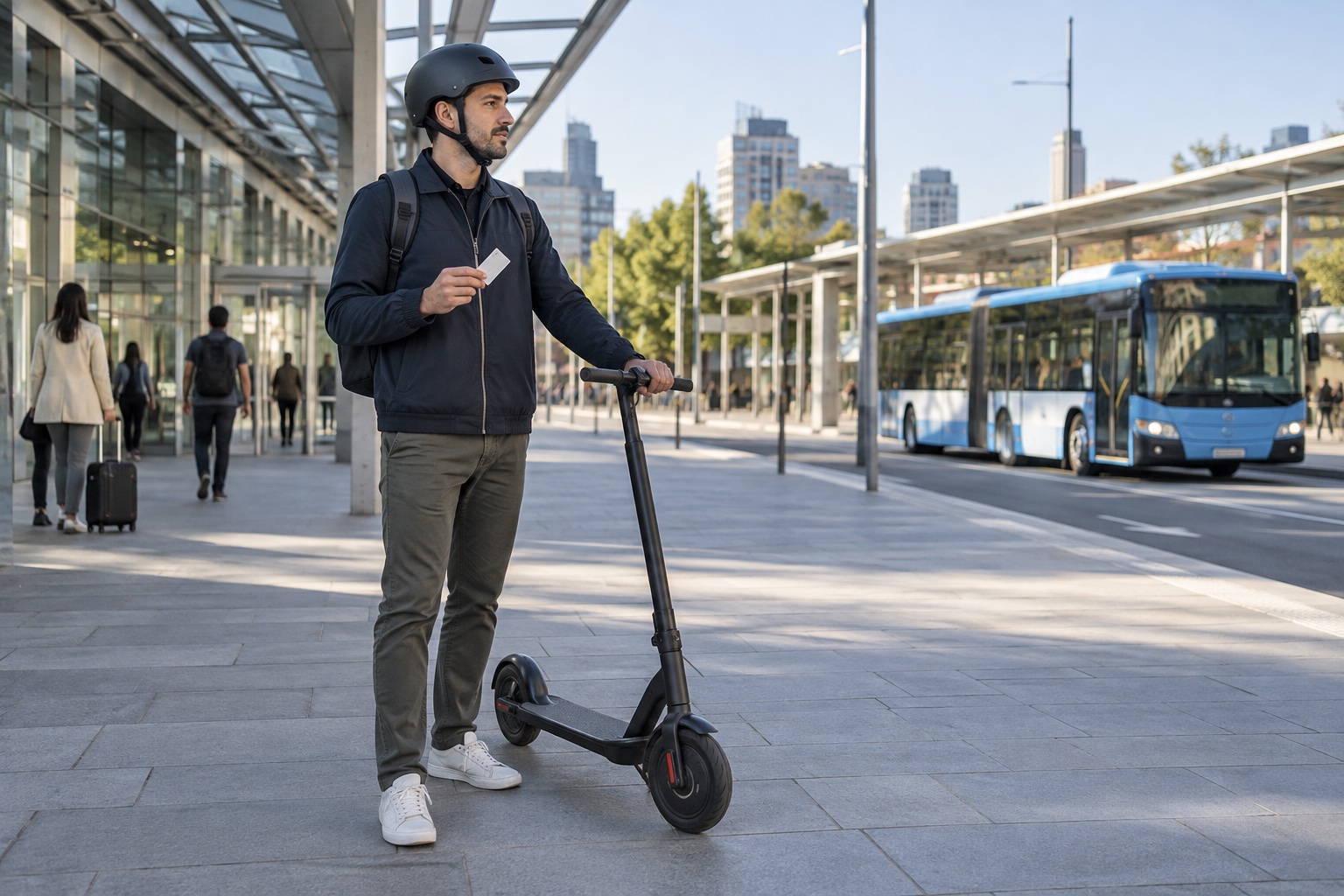

The electric scooter seems like a thoroughly modern invention, a symbol of 21st-century urban mobility that appeared in our cities almost overnight. When asked who invented it, many might think of the tech entrepreneurs who launched the first big sharing companies. However, the story of the electric scooter is far more complex and stretches back over a century. The question of its true inventor doesn’t have a simple answer.
The modern electric scooter wasn’t invented by a single person but is the culmination of over 100 years of innovation, with key contributions from figures like Ogden Bolton Jr. (1895), Arthur Hugo Cecil Gibson (1913), and Wim Ouboter (1990). It evolved from early gas-powered scooters, electric bicycle concepts, and the modern kick scooter.
So, how did we get from clunky, gas-guzzling contraptions to the sleek, silent vehicles we ride today? Here’s the deal… This article will unravel the fascinating history of the electric scooter, introduce the key figures who paved the way, and reveal how this revolutionary device truly came to be.
1. Was the first scooter electric or gas-powered?
To find the origin of the electric scooter, you first have to distinguish between “motorized” and “electric.” The very first commercially produced personal scooters were not electric; they were powered by small internal combustion engines. The most famous of these early models was the Autoped, which appeared in 1915. It was a heavy, noisy, and smoky machine, a far cry from the clean, quiet e-scooters we know today. These early gas-powered scooters were a novelty for the wealthy, but they established the basic concept of a standing platform with two wheels and handlebars.
These gas-powered forerunners were the dominant form of personal scooter for decades. This is important because… they laid the cultural and mechanical groundwork for what would come later. They proved that a small, personal motorized vehicle could be a viable form of transportation, at least in theory. The idea of personal mobility was planted, but the technology was still cumbersome and inefficient.
The transition to electric power happened in fits and starts over many years. While the first motorized scooters were gas-powered, the idea of a personal electric vehicle is actually even older. However, the limitations of early battery technology meant that gasoline remained the more practical, albeit dirtier, power source for most of the 20th century.
| Power Source | First Appearance (Commercial) | Key Characteristics |
| Gasoline | 1915 (Autoped) | Heavy, noisy, polluting, mechanically complex. |
| Electric | Sporadic concepts, modern form in the 1990s | Quiet, clean, simpler mechanics, limited by battery tech. |
| Human Power | Early 1900s | Simple, lightweight, required physical effort. |
2. Who filed the first patent for a personal motorized vehicle?
While the Autoped was the first to be mass-produced, the credit for the first patent for a similar vehicle often goes to Arthur Hugo Cecil Gibson. On July 26, 1913, Gibson, a British inventor, filed a patent for a “Self-Propelled Vehicle.” His design was for a two-wheeled platform with a small, rear-mounted engine and a steering column, conceptually very similar to the scooters that would follow. It was designed to be a simple and economical form of personal transport.
Gibson’s patent is a crucial milestone. The bottom line? It shows that the core idea of a personal motorized scooter existed before the first one ever hit the streets. His detailed drawings laid out a blueprint for a vehicle that was clearly intended for individual urban mobility. It featured a step-through frame and a small engine, demonstrating a vision for a new class of vehicle that was more accessible than a motorcycle.
Whether Gibson’s patented vehicle was ever built is a matter of historical debate. There is no evidence that it went into production. However, his patent predates the launch of the Autoped by two years, making him a strong contender for the title of the conceptual inventor of the motorized scooter. His work proves that the idea was in the air, waiting for the right person to turn it into a commercial product.
| Inventor/Company | Year of Patent/Invention | Key Contribution |
| Arthur Hugo Cecil Gibson | 1913 | Patent for a “Self-Propelled Vehicle,” a conceptual forerunner. |
| Autoped Company | 1915 | First mass-produced gasoline-powered scooter. |
| Ogden Bolton Jr. | 1895 | Patent for an electric bicycle hub motor. |
3. What was the Autoped and who invented it?
The Autoped, launched in 1915 by the Autoped Company of America, holds the title of the first mass-produced motorized scooter. It was a heavy machine with a 155cc, four-stroke, air-cooled engine on its front wheel. It could reach speeds of up to 20 mph, which was quite fast for its time. A clever feature was its foldable steering column, which also acted as the vehicle’s control: pushing it forward engaged the clutch, and pulling back applied the brake.
There is some historical debate over who actually invented the Autoped. While some sources credit Arthur Hugo Cecil Gibson due to his earlier patent, many historians point to Joseph F. Merkel, a well-known engine designer, as the driving force behind the Autoped’s mechanical design. Let me explain… Merkel’s expertise in engines was likely key to making the Autoped a functional, producible vehicle, even if the base concept wasn’t his own.
The Autoped was marketed to everyone from postmen and delivery boys to women and socialites, advertised as the perfect vehicle for that first or last mile of a commute. It was even used by the New York Postal Service. Despite its innovative design, the Autoped was expensive and heavy, and it ultimately failed to achieve widespread commercial success. However, its influence was significant, establishing the scooter as a new category of urban vehicle.
| Feature | Description | Significance |
| Engine | 155cc, 4-stroke, front-wheel mounted | One of the first uses of a compact engine for personal mobility. |
| Controls | Push/pull steering column for clutch/brake | An early, intuitive control scheme. |
| Foldable Steering | The steering column could be folded for storage | A precursor to the modern emphasis on portability. |

4. Were there any early electric scooter concepts?
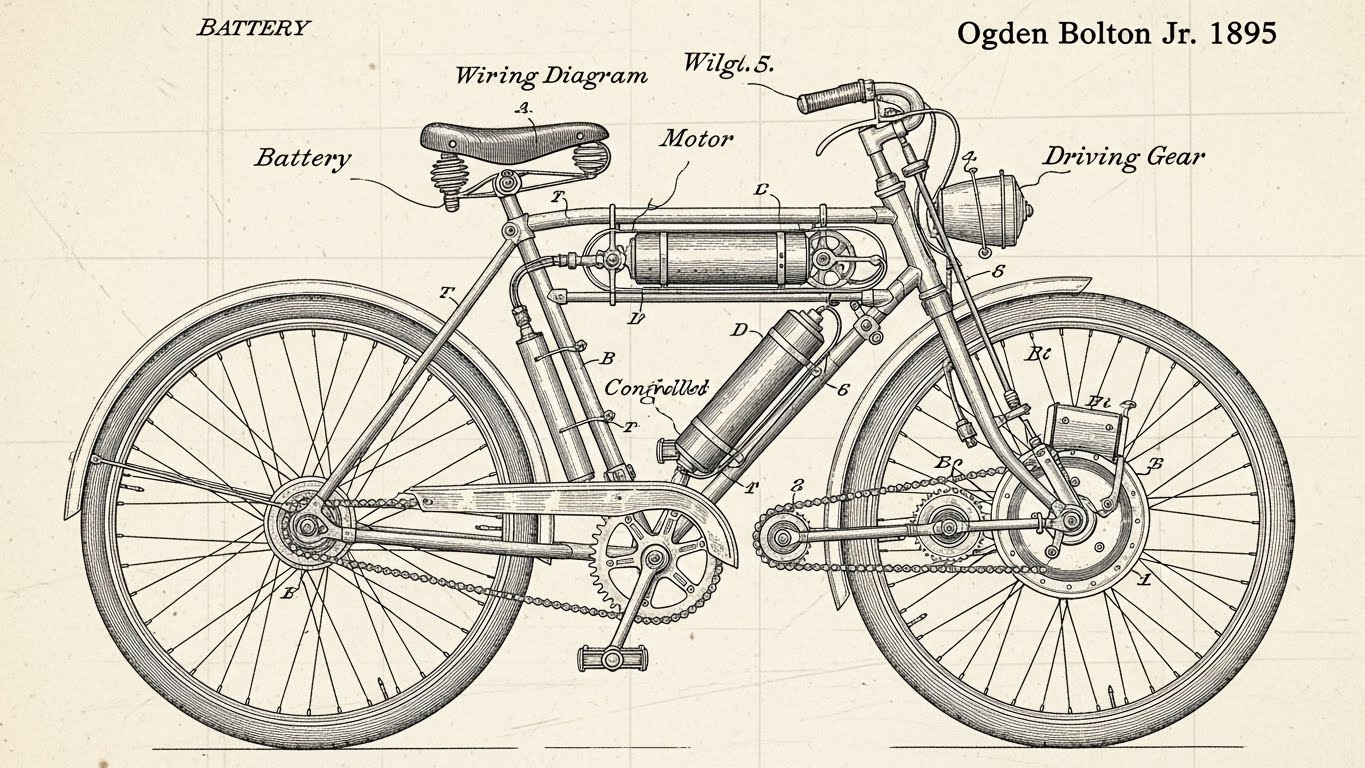
Yes, the idea of a personal electric vehicle is surprisingly old, predating even the first gas-powered scooters. As far back as 1895, an inventor named Ogden Bolton Jr. was granted a patent for an “electrical bicycle.” His design featured a direct-current (DC) hub motor mounted in the rear wheel. This was a revolutionary concept and is one of the earliest documented examples of a direct-drive hub motor, the same technology that powers most modern electric scooters.
Bolton’s patent didn’t include a battery in the drawings, but it laid the essential groundwork for electrifying a two-wheeled vehicle. Around the same time, companies like the Ajax Motor Vehicle Company in New York were also experimenting with electric vehicles. But here’s the thing… the primary obstacle for all these early electric pioneers was the battery. The lead-acid batteries of the era were incredibly heavy, offered very limited range, and took a long time to charge.
This technological hurdle is why gasoline-powered vehicles, including the Autoped, became dominant in the early 20th century. The energy density of gasoline was simply far superior to what batteries could offer. While the concept of the electric scooter existed in these early patents, the technology required to make it a practical and desirable product wouldn’t be available for nearly a century.
| Early Electric Pioneer | Year | Innovation |
| Ogden Bolton Jr. | 1895 | Patent for a rear-wheel electric hub motor for a bicycle. |
| Hosea W. Libbey | 1897 | Patent for an electric bicycle powered by a double electric motor. |
| Ajax Motor Vehicle Co. | c. 1900 | Early manufacturer that experimented with electric vehicles. |
5. How did the 1990s kick-scooter revival influence modern e-scooters?
The direct ancestor of the sleek, foldable e-scooter we see everywhere today is not the heavy Autoped, but the lightweight kick scooter that became a global phenomenon in the 1990s. This revival was spearheaded by a Swiss banker named Wim Ouboter. He wanted a convenient way to cover the “micro-distance” to his favorite sausage shop, a journey too short for a car but too long to walk comfortably. His solution was a light, foldable scooter that he could easily carry.
Ouboter’s invention, which would eventually become the Razor scooter, was a masterpiece of simplicity and portability. It was made of lightweight aluminum and had a simple folding mechanism that made it easy to carry onto a bus or into a building. Want to know the secret? This focus on solving the “last mile problem” was the key. The scooter wasn’t just a toy; it was a practical tool for urban commuting.
The immense popularity of the Razor scooter in the late 1990s and early 2000s put the kick scooter form factor back into the public consciousness. It created a massive, global market for a product that was lightweight, portable, and fun. This created the perfect foundation for the next logical step: adding an electric motor and a battery to this already popular and proven design.
| Development Stage | Key Figure/Company | Core Contribution |
| The Problem | Wim Ouboter | Identified the need for a “micro-distance” vehicle. |
| The Solution | Wim Ouboter / Micro Mobility Systems | Created a lightweight, foldable kick scooter. |
| The Result | RazorUSA | Popularized the kick scooter globally, creating a foundation for e-scooters. |
6. What role did the Segway play in personal mobility?
No discussion of modern personal electric mobility is complete without mentioning the Segway. Invented by the prolific Dean Kamen and unveiled in 2001, the Segway PT was a self-balancing, two-wheeled personal transporter. It used a complex system of gyroscopes and sensors to stay upright, and the rider controlled it by simply leaning forward or backward. It was a technological marvel that captured the world’s imagination.
The Segway was not a scooter in the traditional sense, but its impact was profound. You need to know this… it was the first personal electric vehicle to be taken seriously by the mainstream media and the public. It was hailed as the future of urban transportation and, although it never quite lived up to the hype, it normalized the idea of adults riding small, electric-powered vehicles on sidewalks and in bike lanes.
While the Segway itself was too expensive and bulky for mass adoption, its technology and cultural impact were significant. It pushed the development of battery technology, electric motors, and sensor systems. It also shifted the public perception of what a personal vehicle could be. In a way, the Segway’s ambitious vision for a revolution in personal transport helped create a more receptive environment for the simpler, more accessible electric scooter that would follow.
| Device | Inventor | Key Technology | Impact on E-Scooters |
| Segway PT | Dean Kamen | Dynamic Stabilization (Self-Balancing) | Normalized personal electric vehicles, pushed sensor tech. |
| iBOT | Dean Kamen | Self-balancing wheelchair (precursor to Segway) | Proved the viability of the core balancing technology. |
| Electric Scooter | (Multiple) | Hub Motor, Lithium-Ion Battery | Benefited from the cultural shift the Segway created. |
7. Who is considered the “father” of the modern electric scooter?
Assigning the title of “father” of the modern electric scooter to a single person is difficult because it was a synthesis of several key innovations. However, if one had to choose the person who created the direct lineage to today’s e-scooters, the strongest case could be made for Wim Ouboter. While he didn’t invent the electric part, he invented the scooter part as we know it today: a lightweight, foldable, portable vehicle designed for the last mile.
Before Ouboter, motorized scooters were often heavy, non-foldable, and closer to mopeds, like the products made by Go-Ped in the 1980s. Go-Ped was a significant player, creating powerful stand-up scooters, but their focus was more on recreation and performance than on commuter portability. The bottom line is this… Ouboter’s design philosophy was different. He prioritized convenience and portability above all else.
The modern e-scooter is essentially Ouboter’s kick scooter design with three crucial additions: a lithium-ion battery, a brushless hub motor, and a sophisticated electronic control system. These technologies matured in the 2000s, and when they were combined with Ouboter’s brilliant form factor, the modern electric scooter was born. He created the vessel that was waiting to be electrified.
| Contender | Claim to the Title | Why They Aren’t the Sole Inventor |
| Wim Ouboter | Invented the modern, foldable kick scooter form factor. | His original design was not electric. |
| Ogden Bolton Jr. | Patented the electric hub motor in 1895. | His patent was for a bicycle, and the tech was not yet viable. |
| Dean Kamen | Popularized personal electric transport with the Segway. | The Segway is a different class of vehicle, not a scooter. |

8. How did the rise of ride-sharing popularize e-scooters?
While the technology for a good electric scooter existed by the mid-2000s, it remained a niche product. The catalyst that propelled e-scooters into a global phenomenon was the rise of dockless ride-sharing. In 2017, a company called Bird launched the first large-scale dockless electric scooter sharing system in Santa Monica, California. This was quickly followed by competitors like Lime, Spin, and many others.
The ride-sharing model was revolutionary. You need to understand this… it removed the biggest barrier to adoption: the upfront cost of purchasing a scooter. Suddenly, for just a few dollars, anyone with a smartphone could try one out. People could use them for a short trip and simply leave them at their destination. This unprecedented accessibility led to an explosion in popularity.
Venture capital funding poured into these new companies, allowing them to deploy tens of thousands of scooters in cities all over the world, seemingly overnight. This massive, visible presence turned the electric scooter from a novelty into a common sight and a legitimate mode of urban transportation. The sharing economy didn’t invent the e-scooter, but it put it on the map and into the hands of millions.
| Ride-Sharing Company | Year Founded | Key Impact |
| Bird | 2017 | Pioneered the dockless e-scooter sharing model in the US. |
| Lime | 2017 | Became a major global competitor, rapidly expanding the market. |
| Spin | 2016 | Another early player that contributed to the rapid growth. |
9. What are the key technological milestones in e-scooter history?
The journey from the Autoped to a modern Dynamic Scooter is a story of key technological advancements. The single most important milestone was the development of the lithium-ion battery. Commercialized in the early 1990s, these batteries offered a much higher energy density and lower weight compared to the lead-acid batteries of the past. This was the breakthrough needed to make portable electric vehicles practical.
Another critical innovation was the brushless DC hub motor. These motors are compact enough to fit inside the wheel of a scooter, are highly efficient, require very little maintenance, and can provide significant torque for climbing hills. The combination of a lightweight battery and a powerful, compact motor is the heart of every modern e-scooter. The best part? These components became affordable and widely available in the 2000s.
Finally, the integration of smart technology completed the package. The rise of the smartphone allowed for features like GPS tracking, mobile app-based unlocking and payment (for sharing services), and Bluetooth connectivity for personal scooters. This allowed users to track their rides, customize performance settings, and secure their vehicles, making the e-scooter a truly smart device.
| Technology | Decade of Impact | Role in E-Scooter Evolution |
| Lithium-Ion Battery | 1990s – 2000s | Provided the necessary lightweight, high-density power source. |
| Brushless Hub Motor | 2000s | Enabled powerful, efficient, and low-maintenance direct-drive systems. |
| Smartphone/GPS | 2010s | Enabled the dockless sharing model and smart features for personal owners. |

10. So, who truly invented the electric scooter?
After tracing its long and winding history, it’s clear that the electric scooter does not have a single inventor. It is a classic example of convergent evolution, where different technologies and ideas developed separately over a long period and then came together to create something new. There is no single “aha!” moment, but rather a series of crucial contributions from many different people.
Ogden Bolton Jr. patented the core motor technology in 1895. Arthur Hugo Cecil Gibson conceptualized the motorized scooter form factor in 1913. The Autoped company brought the first one to market in 1915. Wim Ouboter reinvented it as a portable, last-mile solution in the 1990s. And companies like Bird and Lime used smartphone technology to make it accessible to everyone in the 2010s. The bottom line is this… each of these figures is a part of the story.
To ask who invented the electric scooter is like asking who invented the computer or the automobile. The answer is not a person, but a process. It’s a story of more than a century of imagination, engineering, and refinement. The sleek, efficient vehicle you see on the street today stands on the shoulders of countless inventors and innovators. For your own piece of this incredible history, check out the latest models from Dynamic Scooter, which represent the pinnacle of this long evolutionary journey.
Conclusion
The question of who invented the electric scooter is less about finding a single name and more about appreciating a long and fascinating history of innovation. From the earliest concepts of personal electric vehicles in the 1890s to the gas-guzzling Autoped of the 1910s, and from the kick scooter revival of the 1990s to the ride-sharing explosion of the 2010s, the modern e-scooter is a product of many minds and many eras. It required the convergence of lightweight materials, powerful batteries, efficient motors, and smart technology to become the revolutionary vehicle it is today.
So, the next time you hop on your scooter, you’re not just taking a ride; you’re participating in a story of mobility that’s over a century in the making. To experience the latest chapter in this story, explore the advanced and reliable lineup from Dynamic Scooter.

FAQ
Q1: Was the first scooter really invented in the 1890s?
The first patent for a technology core to modern e-scooters—the electric hub motor—was filed by Ogden Bolton Jr. in 1895 for a bicycle. The first mass-produced gas-powered scooter, the Autoped, appeared in 1915.
Q2: Is the Segway an electric scooter?
No, the Segway is a self-balancing personal transporter. While it’s a personal electric vehicle, its technology and riding style are very different from a traditional electric scooter. However, it played a key role in popularizing the idea of personal electric mobility.
Q3: Who invented the first foldable scooter?
Wim Ouboter is widely credited with inventing the first modern, lightweight, foldable kick scooter in the 1990s. This design became the foundation for the Razor scooter and the form factor of most modern electric scooters.
Q4: Why did it take so long for electric scooters to become popular?
The primary reason was battery technology. It wasn’t until the commercialization and cost reduction of lightweight, high-energy-density lithium-ion batteries in the 1990s and 2000s that a practical and affordable electric scooter became possible.
Q5: What company started the electric scooter sharing trend?
Bird, founded by Travis VanderZanden, is credited with launching the first large-scale dockless electric scooter sharing system in Santa Monica, California, in 2017, kicking off the global ride-sharing boom.