
Electric scooters have become a popular transportation option for short-distance travel. Let me break this down for you – understanding battery life helps you plan trips better and avoid getting stranded.
Electric scooter batteries typically last between 5 to 40 miles per charge depending on various factors. Most commuter models average 15-25 miles under normal conditions. The actual range depends on battery capacity, rider weight, terrain type, weather conditions, and riding habits.
But wait, there’s more to discover! Let’s explore exactly how these battery factors affect your daily rides.
1. What factors affect electric scooter battery range?
You might be surprised by how many variables impact your electric scooter’s range. Battery performance is affected by numerous factors working together.
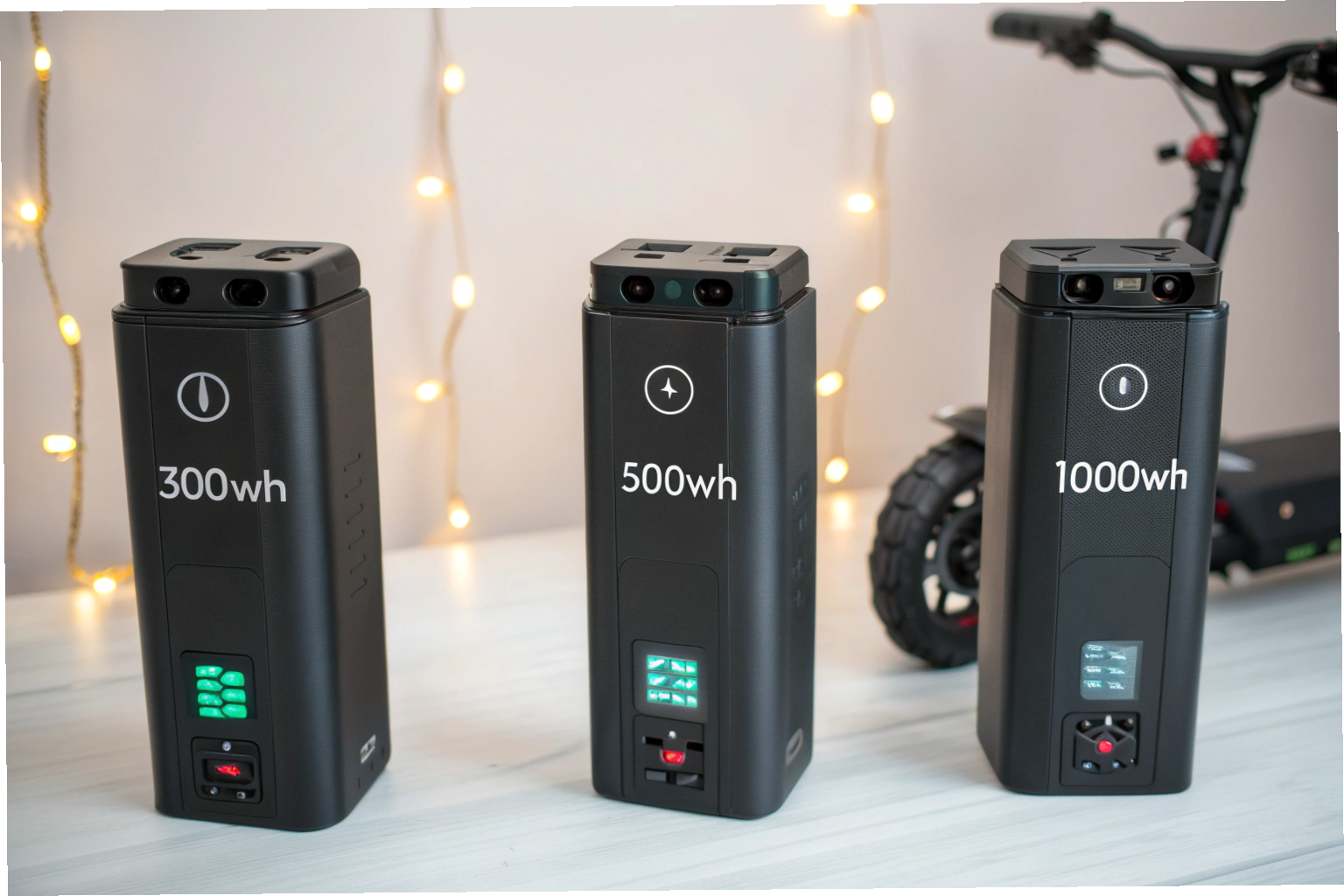
The battery type and capacity serve as the foundation for range potential. Most electric scooters use lithium-ion batteries, measured in watt-hours (Wh). Higher capacity batteries store more energy, allowing for longer rides.
Rider weight directly impacts range because heavier loads require more power. Most manufacturers test with riders weighing around 150-165 pounds. For every 20-30 pounds above this, expect a 5-10% decrease in range.
Terrain dramatically affects battery consumption. Flat surfaces allow efficient energy use, while hills demand significantly more power. A 10% grade hill can reduce range by 50% compared to flat terrain.
| Factor | Impact on Range | Approximate Range Reduction |
|---|---|---|
| Rider Weight | Each 20-30 lbs over test weight | 5-10% decrease |
| Incline | 10% grade hills | Up to 50% decrease |
| Speed | Maximum speed vs. moderate speed | 30-40% decrease |
| Cold Weather | Below 40°F/4°C | 20-30% decrease |
| Wind | Strong headwind | 10-15% decrease |
Speed significantly impacts range. Higher speeds require exponentially more power due to increased air resistance. Aggressive riding with frequent full-throttle acceleration can reduce range by 30-40%.
Weather conditions play a crucial role. Cold temperatures particularly affect lithium-ion chemistry, temporarily reducing capacity. Riding in temperatures below 40°F (4°C) can decrease range by 20-30%.
2. What is the average battery runtime for different types of electric scooters?
Here’s something you should know – not all electric scooters offer the same range capabilities. The market divides into three categories.
Entry-level electric scooters typically offer ranges between 12-15 miles (19-24 km) per charge. These budget-friendly models usually feature smaller battery packs (250-300Wh) and take 4-5 hours to charge.
Commuter electric scooters represent the mid-range segment with ranges between 15-30 miles (24-48 km). Battery capacities typically range from 350-600Wh with 5-7 hour charging times.
| Scooter Category | Typical Range | Battery Capacity | Charging Time | Average Price |
|---|---|---|---|---|
| Entry-level | 12-15 miles (19-24 km) | 250-300Wh | 4-5 hours | $300-$500 |
| Commuter | 15-30 miles (24-48 km) | 350-600Wh | 5-7 hours | $600-$1,200 |
| Performance | 30-60+ miles (48-97+ km) | 700-1600Wh | 8-12 hours | $1,200-$3,000+ |
| Dynamic Scooter Model B | Up to 20 km (12 miles) | Detachable lithium battery | 3-4 hours | $375.37 |
Performance electric scooters deliver impressive ranges between 30-60+ miles (48-97+ km). These premium models feature battery capacities exceeding 700Wh and weigh 60-100+ pounds.
Dynamic Scooter Model B offers competitive range in the commuter category with up to 20 km (12 miles) per charge. Its detachable lithium battery allows convenient charging without moving the entire scooter.

3. How can you maximize your electric scooter’s battery life?
Want to know the secret to getting more miles from each charge? Proper battery care and riding techniques can significantly extend your range.
Adopt proper charging habits. Avoid letting your battery completely drain – lithium-ion batteries prefer partial discharge cycles. Maintain charge levels between 20% and 80% for optimal longevity. Use only the manufacturer-provided charger.
Prevent complete discharge to protect your battery from damage. Lithium-ion batteries can suffer permanent capacity loss when fully depleted.
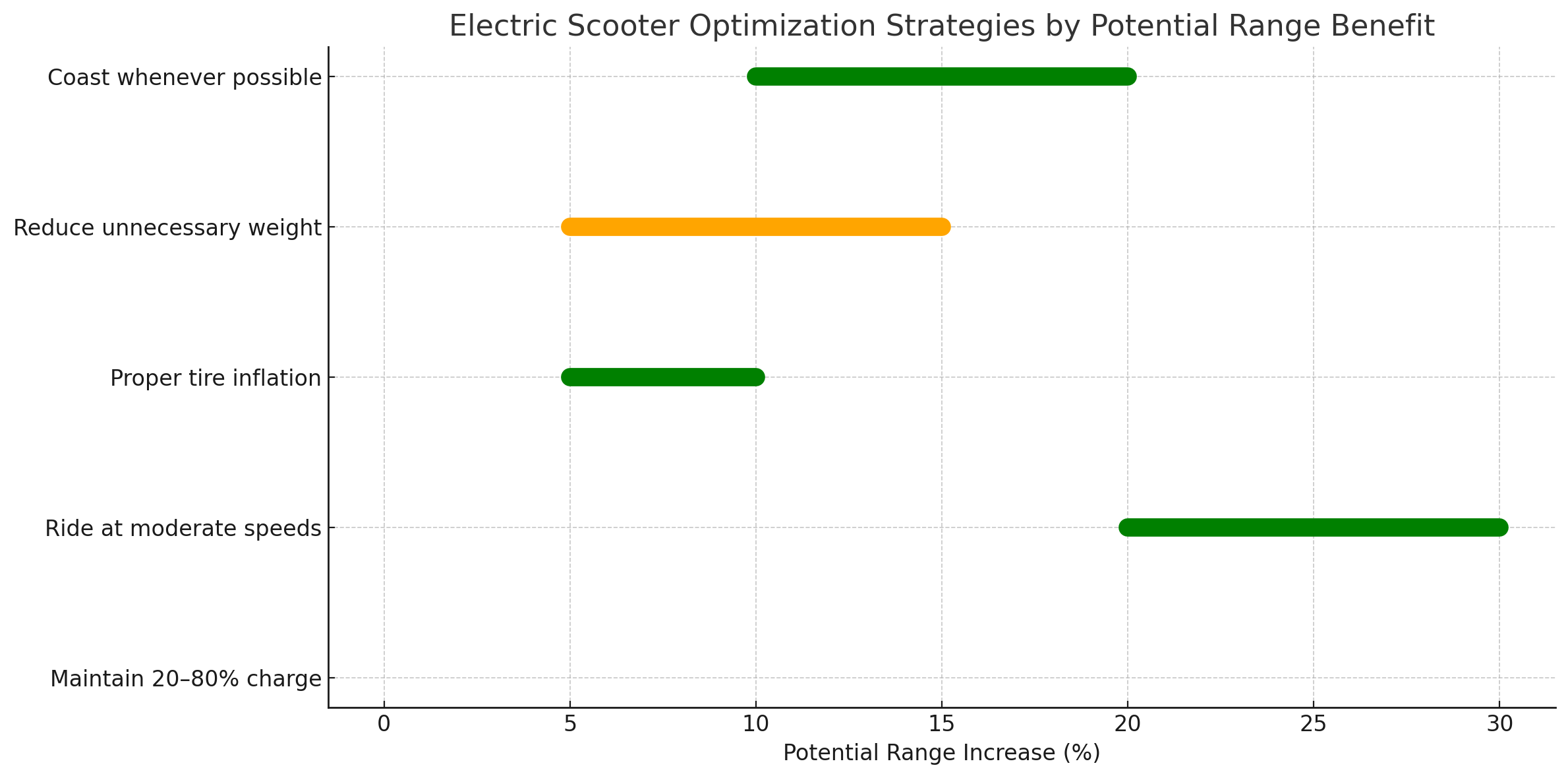
| Optimization Strategy | Potential Range Increase | Implementation Difficulty |
|---|---|---|
| Maintain 20-80% charge | 10-15% longer battery lifespan | Easy |
| Ride at moderate speeds | 20-30% more range per charge | Easy |
| Proper tire inflation | 5-10% more range per charge | Easy |
| Reduce unnecessary weight | 5-15% more range per charge | Moderate |
| Coast whenever possible | 10-20% more range per charge | Easy |
Store your scooter at appropriate temperatures. Lithium-ion batteries prefer moderate temperatures between 50-77°F (10-25°C). Extreme heat accelerates degradation even when not in use.
Adjust your riding habits. Accelerate gradually rather than applying full throttle. Maintain steady speeds instead of constantly varying pace. Keep tires properly inflated to reduce rolling resistance.
4. How long does it take to charge an electric scooter battery?
You might wonder how long you’ll need to wait before riding again after depleting your battery. Charging times vary based on battery capacity and charger specifications.
Different capacity batteries require different charging times. Entry-level scooters with 250-300Wh batteries typically charge in 3-5 hours. Mid-range commuter scooters with 350-600Wh batteries generally require 5-7 hours. High-performance models with 700-1600Wh packs may need 8-12 hours.
Charger specifications significantly impact charging duration. Standard chargers typically output 1.5-2A, while fast chargers may deliver 3-5A or more.
| Battery Capacity | Standard Charger (2A) | Fast Charger (4A) | Ultra-Fast Charger (6A) |
|---|---|---|---|
| 250Wh (Small) | 3-4 hours | 1.5-2 hours | 1-1.5 hours |
| 500Wh (Medium) | 6-7 hours | 3-3.5 hours | 2-2.5 hours |
| 1000Wh (Large) | 10-12 hours | 5-6 hours | 3.5-4 hours |
| 1500Wh (XL) | 15-18 hours | 7.5-9 hours | 5-6 hours |
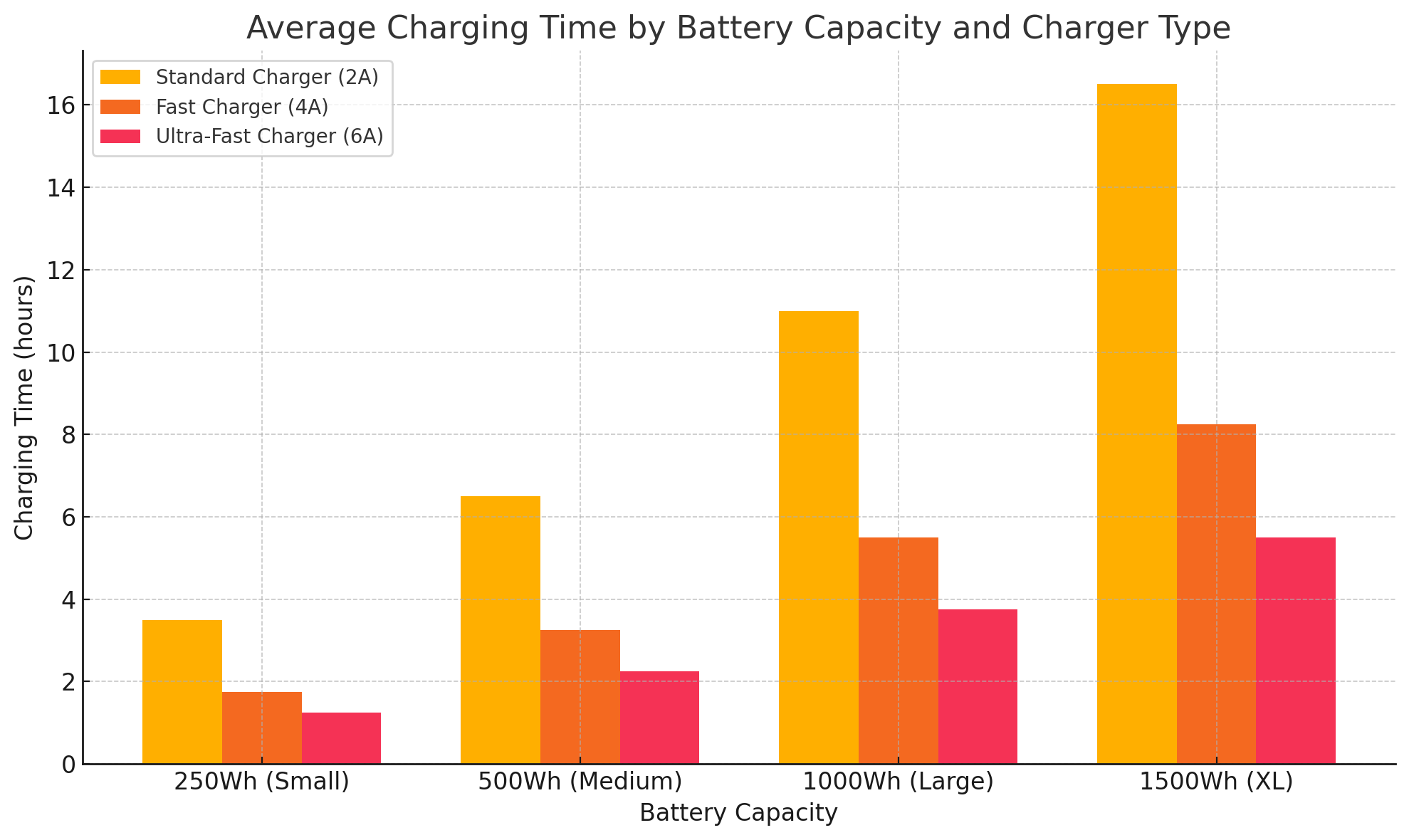
Lithium-ion batteries charge in three main phases. The first phase (constant current) occurs when the battery is mostly depleted, charging relatively quickly to about 80% capacity. The second phase (constant voltage) slows down as the battery approaches full. The final phase (trickle charging) tops off the remaining capacity very slowly.
First-time charging requires special attention. Many manufacturers recommend an initial charge of 8-12 hours to calibrate the battery management system.
5. How many charging cycles can an electric scooter battery last?
Let’s talk about the long-term durability of your investment. Battery lifespan is measured in charging cycles.
The average lifecycle of lithium-ion batteries typically ranges from 300 to 500 complete charging cycles before capacity noticeably decreases. After these cycles, batteries don’t suddenly fail but gradually lose capacity to about 70-80% of original.
Several factors affect cycle life. Charging habits significantly impact lifespan – consistently charging from empty to full causes more stress than partial charging between 20% and 80%. Operating temperature plays a crucial role, with extreme heat accelerating degradation.
| Battery Usage Pattern | Expected Cycle Life | Capacity After 2 Years |
|---|---|---|
| Optimal care (20-80% charges, moderate temps) | 500-1000 cycles | 85-90% of original |
| Average use (full charges, varied temps) | 300-500 cycles | 75-85% of original |
| Heavy use (frequent deep discharge, extreme temps) | 200-300 cycles | 60-75% of original |
| Poor maintenance (constant full charge, hot storage) | 150-250 cycles | Below 60% of original |
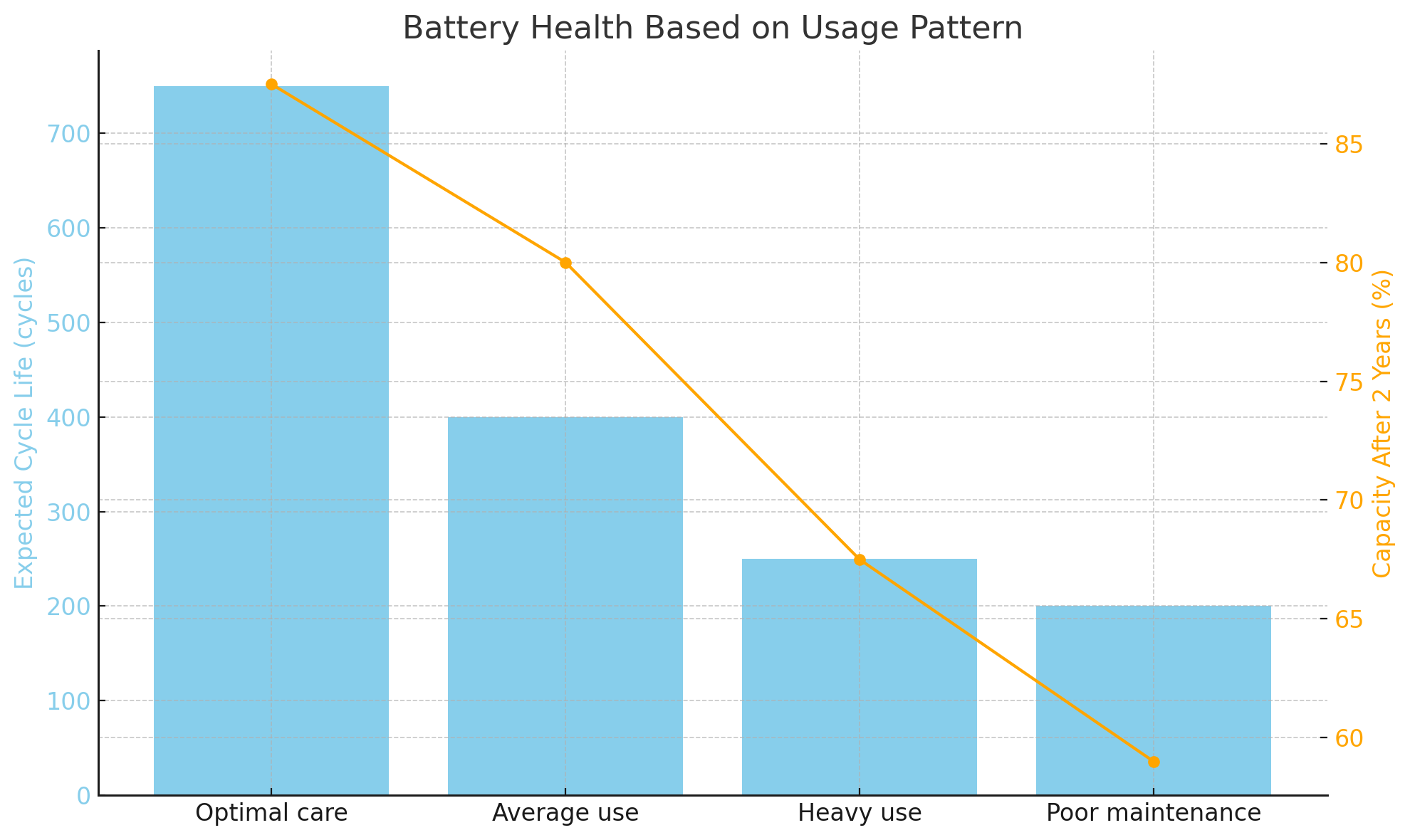
Signs of battery degradation include decreased range, faster discharge rates, and longer charging times. To extend cycle life, avoid complete discharges, don’t routinely charge to 100%, and store in moderate temperatures.
6. How do you know when an electric scooter battery needs replacement?
Ever wondered how to tell if your battery needs replacing? Identifying issues early helps avoid unexpected problems.
Many modern scooters connect to smartphone apps that display battery health information, including current capacity percentage compared to original specifications.
Common symptoms include significantly reduced range (30% or more), power fluctuations during rides, unexpected shutdowns, and batteries that heat excessively during charging.
| Warning Sign | Possible Cause | Recommended Action |
|---|---|---|
| Range reduced by >30% | Normal cell degradation | Consider replacement |
| Battery swelling | Cell damage/failure | Immediate replacement |
| Won’t hold charge | Cell failure or BMS issue | Replacement needed |
| Excessive heat during charging | Damaged cells or charger issue | Stop use, diagnostic testing |
| Intermittent power cutouts | Cell imbalance or BMS problems | Professional evaluation |
Diagnostic methods include capacity testing (measuring actual range after full charge) and voltage testing under load. When deciding between replacement and repair, consider that complete replacement is straightforward but costly, while cell replacement may save money but creates potential balance issues.
7. What is the maintenance cost of electric scooter batteries?
You might be wondering about the financial aspect of battery ownership. Understanding these costs helps with budgeting.
Replacement batteries vary in price based on capacity and quality. Entry-level scooter batteries typically cost $100-250, mid-range commuter batteries $250-500, and high-performance batteries $500-1000+.
DIY replacement can save $50-150 in labor costs but requires technical skills. Professional installation costs $50-150 depending on the scooter model.
| Scooter Type | Battery Replacement Cost | Professional Installation | Total Replacement Cost |
|---|---|---|---|
| Entry-level | $100-250 | $50-100 | $150-350 |
| Commuter | $250-500 | $75-125 | $325-625 |
| Performance | $500-1000+ | $100-150 | $600-1150+ |
Warranty periods typically range from 6 months to 2 years, with most guaranteeing 70-80% of original capacity. Based on typical usage, budget for battery replacement every 2-3 years.
8. How do electric scooter batteries perform in different weather conditions?
Did you know that weather dramatically affects battery performance? Understanding these effects helps you adapt your riding habits.
Cold weather reduces range by 20-30% when riding below 40°F (4°C) compared to optimal 70°F (21°C). This reduction is temporary – the battery returns to normal when warmed.
Hot weather doesn’t immediately reduce capacity but accelerates degradation. Operating or charging above 100°F (38°C) can significantly shorten battery lifespan.
| Weather Condition | Effect on Range | Effect on Battery Lifespan | Recommended Actions |
|---|---|---|---|
| Cold (Below 40°F/4°C) | 20-30% decrease | Minimal long-term impact | Store indoors, pre-warm battery |
| Hot (Above 90°F/32°C) | 5-10% decrease | Accelerated degradation | Avoid direct sun, charge during cooler hours |
| Rain/High Humidity | 5-15% decrease | Potential water damage risk | Ensure proper sealing, dry before storage |
| Extreme Cold (Below 20°F/-7°C) | Up to 50% decrease | Potential charging damage | Warm before charging, avoid deep discharge |
| Extreme Heat (Above 105°F/40°C) | System may limit power | Significant degradation | Avoid operation, seek shade, delay charging |
Most scooters have water-resistant battery enclosures (typically IP54 rated), but prolonged exposure to moisture can eventually compromise seals. Never charge batteries when extremely cold (below freezing) or hot (above 105°F/40°C).
9. What are the latest advancements in electric scooter battery technology?
You’ll be amazed by how rapidly battery technology continues to evolve. Recent innovations promise to transform electric scooter performance.
Solid-state batteries represent the most significant potential advancement. Unlike conventional lithium-ion batteries with liquid electrolytes, solid-state batteries use solid materials, offering 50-100% more energy density, virtually eliminated fire risk, faster charging, and 2000-3000 cycle lifespans.
Other innovations include silicon-carbon composite anodes (20-40% more capacity), AI-powered battery management systems, and sustainable battery materials.
| Technology | Potential Benefit | Expected Availability | Initial Cost Impact |
|---|---|---|---|
| Solid-State Batteries | 50-100% more range, 2-3x lifespan | 2025-2028 | Premium pricing (+50-100%) |
| Silicon-Carbon Anodes | 20-40% more range, faster charging | Already emerging | Moderate increase (+15-30%) |
| Smart BMS with AI | 10-20% better range utilization | Already available in premium models | Minimal (+5-10%) |
| Structural Batteries | Lighter scooters, more range | 2026-2030 | Initially significant |
| Sustainable Materials | Reduced environmental impact | Gradually increasing | Varies by implementation |
These technologies will likely appear in premium electric scooters first before becoming standard features across price ranges as development costs decrease.

Here’s the truth – battery specifications significantly influence your overall ownership experience. Understanding key factors helps you select a scooter that matches your needs.
Battery capacity (measured in watt-hours) directly correlates with range – higher numbers generally mean longer rides. Some manufacturers list ampere-hours (Ah) instead; multiply this by the battery voltage to calculate watt-hours (Wh = Ah × V).
Warranty periods typically range from 6 months to 2 years. Beyond duration, examine what’s covered – some guarantee only against complete failure, while others promise minimum capacity retention throughout the warranty period.
| Consideration | What to Look For | Why It Matters |
|---|---|---|
| Battery Capacity | Higher Wh rating | Directly impacts range |
| Battery Chemistry | NMC vs LFP | Balances energy density vs lifespan |
| Charging Time | Standard and fast charging options | Affects convenience and usage patterns |
| Warranty Terms | Duration and capacity guarantees | Protects investment and indicates quality |
| Removable vs Built-in | Access and replacement ease | Impacts maintenance and travel options |
| Battery Location | Deck vs stem mounting | Affects weight distribution and handling |
| Cell Brand | Named brands vs generic | Indicates quality and reliability |
Removable batteries allow charging without moving the entire scooter and facilitate easier replacement. Built-in batteries maximize energy density and improve water resistance but complicate charging and replacement.
Look for batteries with UL certification (particularly UL 2272) or equivalent standards like CE marking in Europe. These certifications indicate rigorous safety testing.
Looking for reliable urban transportation? Dynamic Scooter Model B offers the perfect balance of range (12 miles), portability, and convenience with its detachable battery system and smart protection features—ideal for daily commuters.

FAQ Section
Q1: How far can an electric scooter travel on a full charge?
Most electric scooters travel between 12-40 miles (19-64 km) on a full charge under ideal conditions. Entry-level models typically provide 12-15 miles, mid-range commuter scooters offer 15-30 miles, and premium performance models can reach 30-60+ miles per charge. Your actual range depends on multiple factors including rider weight, terrain, speed, weather conditions, and battery age.
Q2: What is the average lifespan of an electric scooter battery?
Electric scooter batteries typically last 300-500 complete charging cycles before noticeable capacity degradation occurs. With average use patterns, this translates to approximately 2-3 years of regular riding. After reaching this cycle count, batteries don’t fail completely but gradually hold less charge, typically retaining 70-80% of original capacity.
Q3: Can I install a larger capacity battery in my electric scooter to increase range?
Installing larger capacity batteries depends entirely on your specific scooter model. Some scooters support official battery upgrades or third-party options with higher capacity. However, limitations include physical space constraints, weight distribution changes affecting handling, potential controller incompatibility with different voltage batteries, and possible firmware restrictions.
Q4: Why is my electric scooter battery range shorter than advertised?
Electric scooter range discrepancies between advertised and actual performance stem from several factors. Manufacturers test under optimal conditions: lightweight riders (usually 150-165 pounds), perfectly flat terrain, constant moderate speeds, new batteries, and ideal temperatures around 70°F (21°C). Real-world conditions rarely match these ideals.
Q5: How should I maintain my electric scooter battery during winter?
Winter battery maintenance requires storing your scooter indoors at room temperature when not in use, as cold temperatures temporarily reduce capacity by 20-50%. Before riding, allow the battery to warm up by keeping the scooter inside and running it for a few minutes at low speed before full operation. Avoid charging immediately after bringing a cold scooter indoors – let it reach room temperature first.