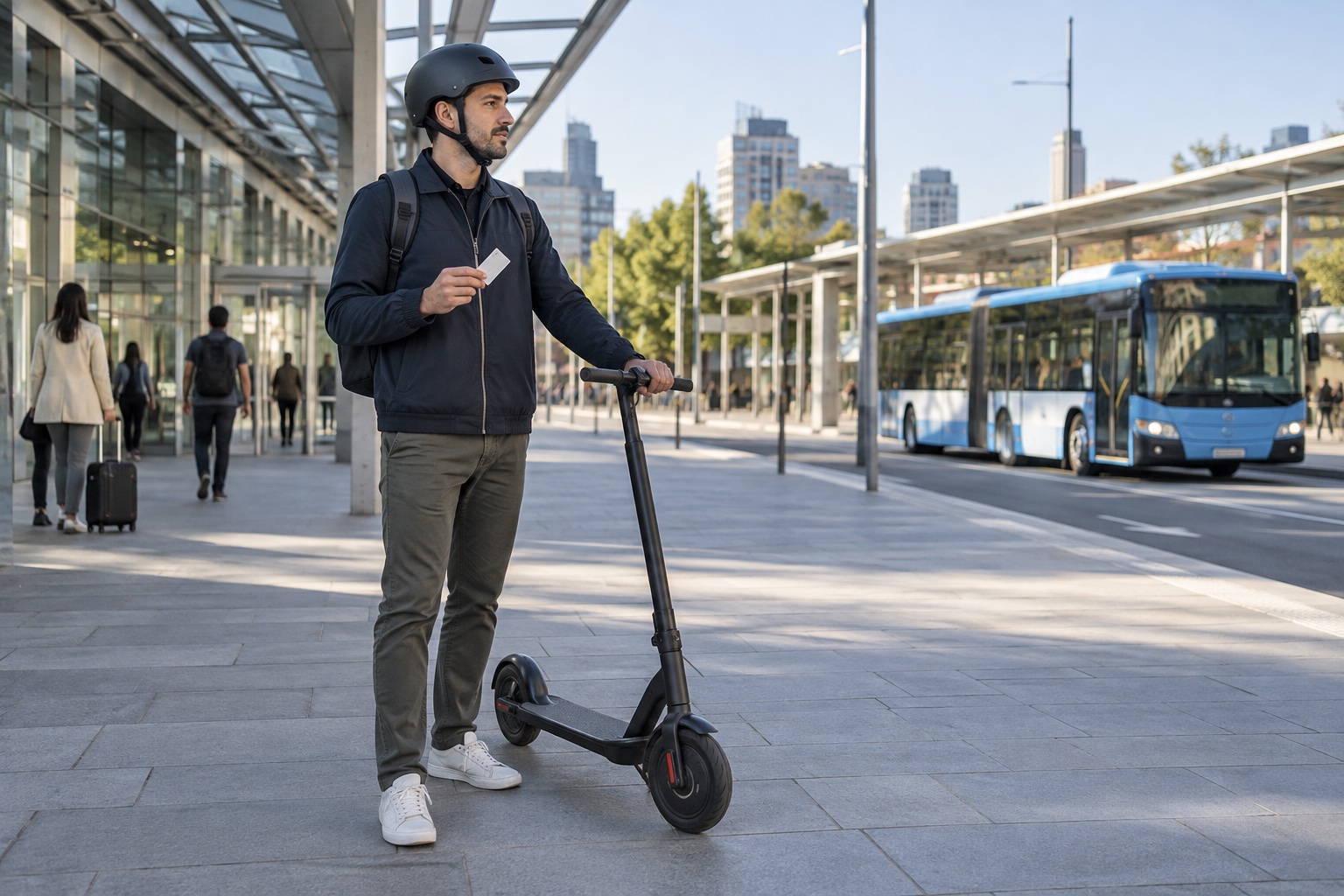

Electric scooters have transformed urban mobility with their convenience and eco-friendly nature. But one question remains at the forefront for potential buyers and current owners alike: How far can an electric scooter go on one charge? This comprehensive guide breaks down everything you need to know about electric scooter range.
1. What is the average range of electric scooters?
The typical electric scooter can travel between 10 and 40 miles on a single charge, but this range varies dramatically across models and price points. Budget scooters often deliver 10-15 miles of range, while mid-tier options typically offer 15-25 miles. Premium models can reach impressive distances of 25-40+ miles per charge.
You might wonder what causes such variation. Well, several factors come into play simultaneously. Battery capacity stands as the primary determinant – measured in watt-hours (Wh), higher capacity batteries store more energy and thus provide longer ranges. Most consumer electric scooters feature batteries ranging from 250Wh to 1000Wh.
Motor efficiency also plays a crucial role in determining range. More efficient motors convert battery power into motion with less waste, allowing riders to travel farther on the same charge. Advanced models from companies like Dynamic Scooter incorporate sophisticated motor management systems that optimize power usage across various riding conditions.
| Price Range | Typical Battery Capacity | Expected Range |
|---|---|---|
| Under $300 | 250-350Wh | 8-12 miles |
| $300-$500 | 350-450Wh | 12-18 miles |
| $500-$800 | 450-600Wh | 15-25 miles |
| $800+ | 600-1000Wh+ | 20-40+ miles |

2. What factors affect electric scooter range?
Battery capacity might seem like the obvious answer, but the story runs much deeper than just battery size. Think about this – two identical scooters with the same battery can achieve vastly different ranges depending on how and where they’re ridden.
Rider weight significantly impacts range – heavier riders require more power to maintain speed. Most manufacturers test their scooters with riders weighing around 150-170 pounds. For every 20 pounds above this benchmark, expect a 5-10% reduction in range.
Terrain type dramatically affects battery consumption. Flat, smooth surfaces allow for maximum efficiency, while hills and rough terrain drain batteries much faster. A scooter rated for 20 miles on flat ground might only achieve 10-12 miles on hilly terrain.
Weather conditions play a surprisingly large role too. Cold temperatures temporarily reduce battery capacity – lithium-ion batteries perform best between 60-80°F (15-27°C). Riding in temperatures below 40°F (4°C) can decrease range by 20-30%.
| Factor | Impact on Range | Example |
|---|---|---|
| Rider Weight | 5-10% reduction per 20lbs over test weight | 200lb rider = ~20% less range |
| Hills/Inclines | 5-15% reduction per degree of average incline | 5° incline = 25-75% less range |
| Temperature | 1-2% reduction per degree below optimal | 40°F = ~30% less range |
| Speed | Higher speeds = exponentially more power | Max speed = 30-50% less range |

3. How do different electric scooter brands compare in terms of range?
Brand differences extend beyond marketing claims – engineering philosophy, component quality, and price positioning all influence range performance. Let’s examine how various market segments compare.
High-end brands like Dualtron, Kaabo, and VSETT have built reputations around exceptional range capabilities. These premium scooters often feature dual motors, massive batteries (sometimes exceeding 1500Wh), and sophisticated battery management systems. Models like the Dualtron Thunder can achieve 50+ miles per charge.
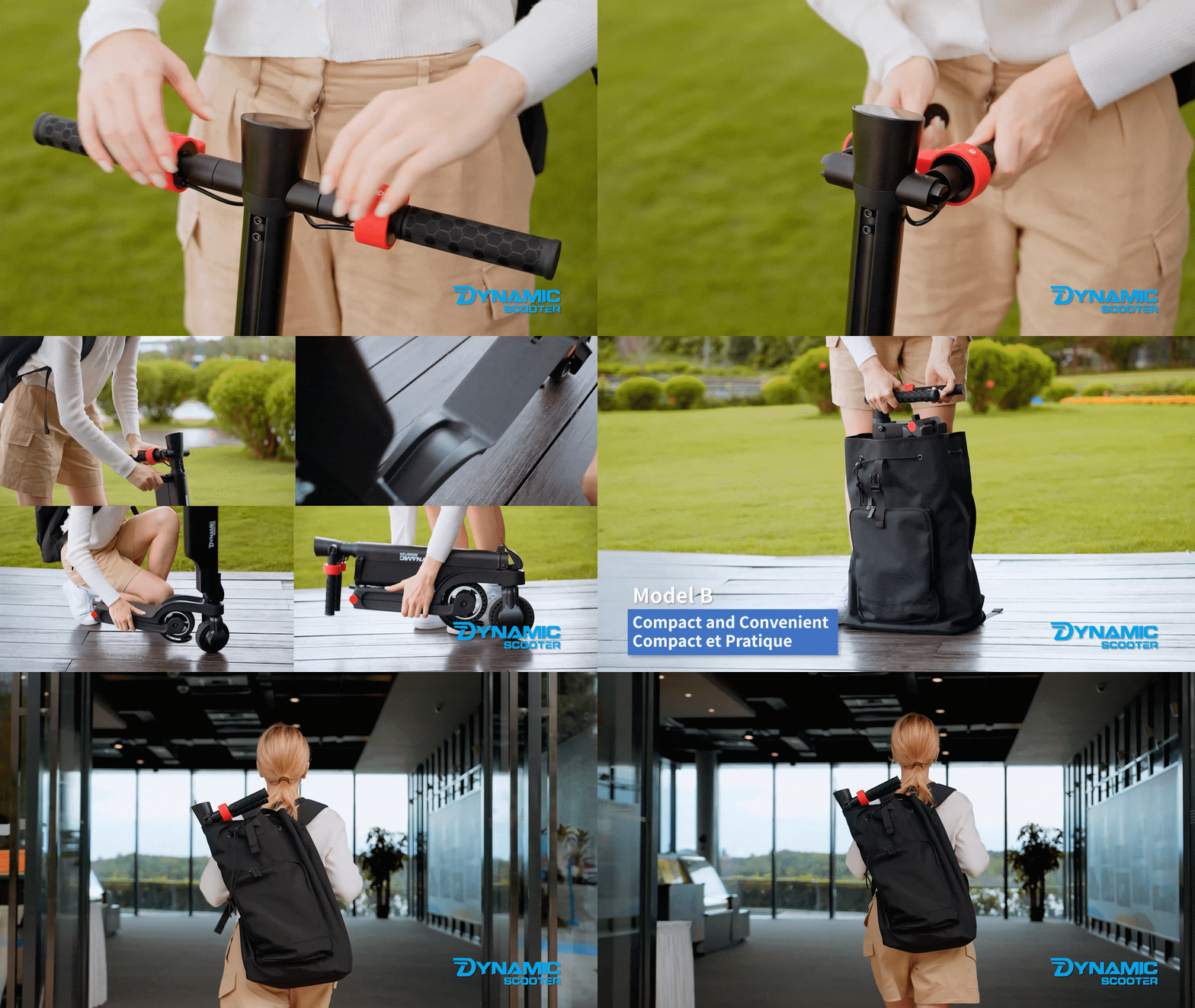
Mid-range manufacturers balance performance with affordability. Brands like Segway-Ninebot, Apollo, and Dynamic Scooter occupy this space with models offering 20-30 miles of real-world range. The Dynamic Scooter Model B exemplifies this category with its 20km (12 miles) range, striking an excellent balance between performance and price.
Budget-friendly options from companies like Gotrax and Hiboy focus on accessibility with lower prices but modest range capabilities. These scooters typically deliver 8-15 miles per charge – sufficient for short commutes but potentially limiting for longer trips.
4. How can you accurately interpret manufacturer range claims?
Manufacturer range claims require careful interpretation since testing methods vary widely across the industry. No standardized testing protocol exists for electric scooters, creating significant inconsistencies in how range figures are determined and reported.
Most manufacturers test under ideal conditions: flat, smooth surfaces; moderate temperatures (65-75°F); riders at or below the weight testing standard (usually 150-170 pounds); and constant, moderate speeds (typically 10-15 mph). These controlled environments maximize range but rarely reflect real-world riding conditions.
A good rule of thumb? Assume you’ll achieve 60-80% of the advertised range under typical conditions. For a scooter claiming 25 miles of range, expect 15-20 miles in real-world use. This mental adjustment helps avoid disappointment and ensures your scooter meets your actual transportation needs.
| Range Claim Type | What It Usually Means | How to Interpret |
|---|---|---|
| “Up to X miles” | Maximum possible under perfect conditions | Expect 60-70% in real-world use |
| “X miles (eco mode)” | Slowest speed setting, flat terrain | Realistic for slow, flat riding only |
| “X-Y miles” | Range from normal to eco mode | Expect closer to X in typical use |
5. How can you maximize your electric scooter’s range?
Extending your scooter’s range doesn’t require technical expertise – simple riding habits and maintenance practices can significantly impact how far you can travel on a single charge. Let’s explore practical strategies that make a real difference.
Riding technique profoundly affects battery consumption. Maintaining a steady, moderate speed conserves energy much more effectively than frequent acceleration and braking. Each time you accelerate, particularly from a complete stop, your scooter draws a surge of power from the battery.
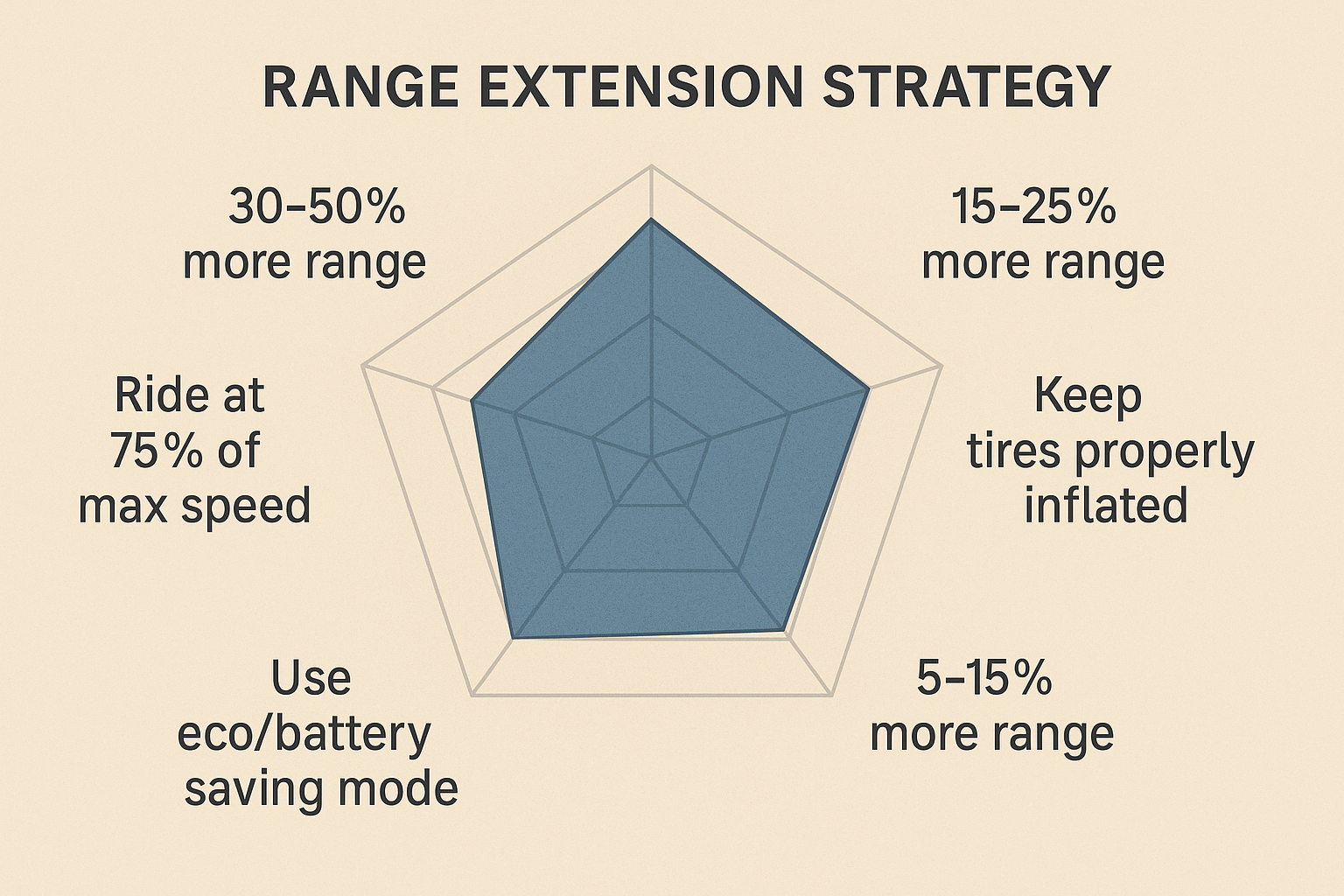
Speed selection represents the single most significant factor under rider control. Higher speeds require exponentially more power due to increased air resistance. Reducing speed from maximum to 75% can increase range by 30-50% in many cases.
Battery maintenance practices preserve capacity over time. Lithium-ion batteries prefer partial discharge cycles rather than complete depletion. Avoiding regular deep discharges (below 10-20% capacity) extends battery lifespan and maintains maximum range capability.
| Range Extension Strategy | Potential Impact | Difficulty Level |
|---|---|---|
| Ride at 75% of max speed | 30-50% more range | Easy |
| Maintain steady speed | 15-25% more range | Moderate |
| Keep tires properly inflated | 5-15% more range | Easy |
| Use eco/battery saving mode | 20-40% more range | Easy |
6. What usage scenarios are long-range electric scooters best suited for?
Different riding scenarios demand different range capabilities. Understanding your typical usage pattern helps determine whether a particular scooter meets your needs or if you should invest in extended range options.
Daily commuters represent the largest electric scooter user segment, with specific range requirements based on commute distance. For one-way commutes under 5 miles, even budget scooters with 10-15 mile ranges provide adequate capacity with a comfortable margin for detours or unexpected trips.
Recreational riders have more flexible range requirements that depend on riding style. Weekend explorers who enjoy longer leisure rides benefit from extended range models that allow for spontaneous route changes without range anxiety.
Travel and tourism applications present unique considerations. Travelers using scooters at destinations need sufficient range to explore tourist areas without returning to charge. Models with 20+ mile ranges typically suffice for most tourist activities.
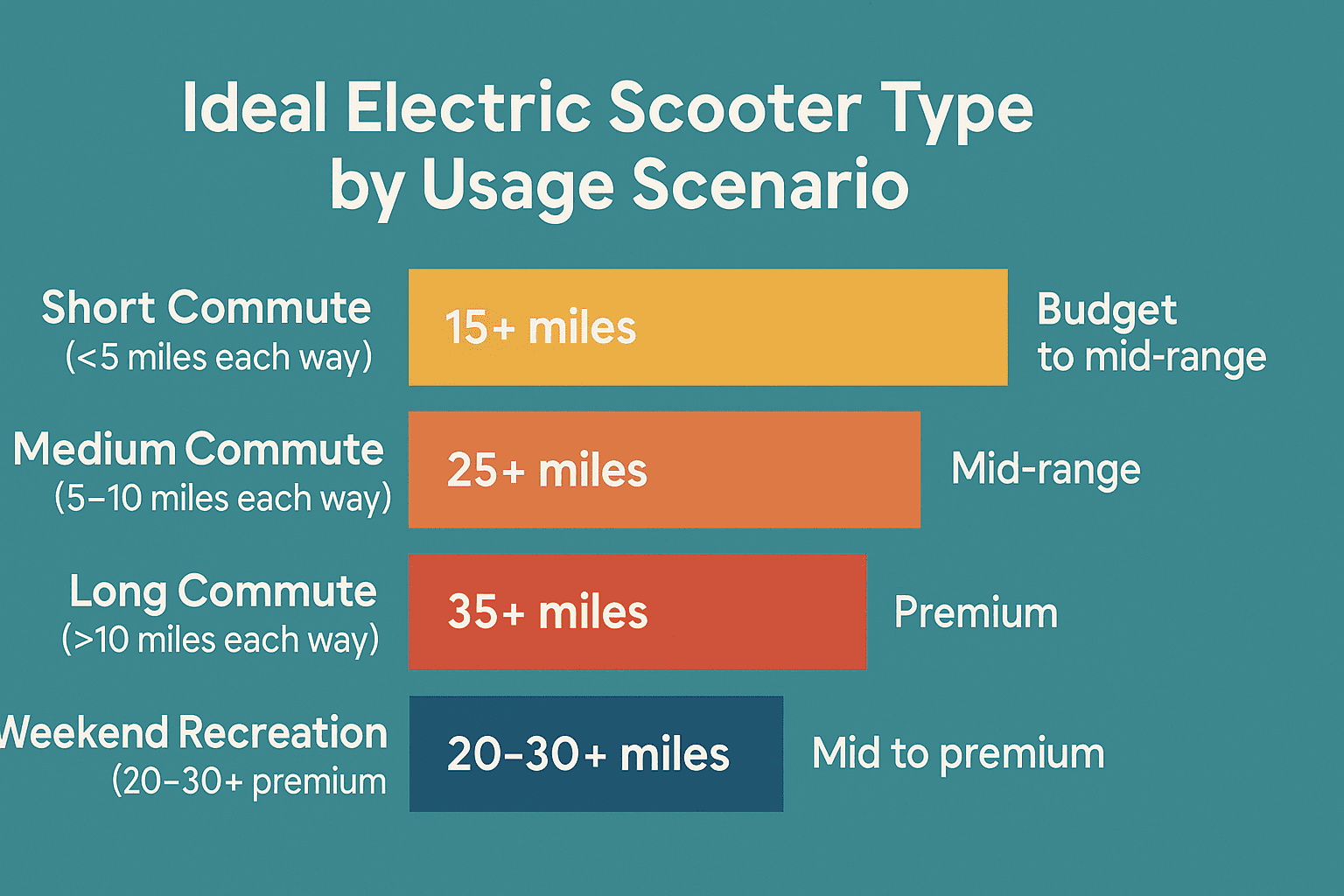
| Usage Scenario | Recommended Range | Ideal Scooter Type |
|---|---|---|
| Short Commute (<5 miles each way) | 15+ miles | Budget to mid-range |
| Medium Commute (5-10 miles each way) | 25+ miles | Mid-range |
| Long Commute (10+ miles each way) | 35+ miles | Premium |
| Weekend Recreation | 20-30+ miles | Mid to premium |
7. What recent developments have occurred in electric scooter battery technology?
Battery technology advances continue to reshape electric scooter capabilities, with several key innovations extending range while improving safety and convenience. The pace of development accelerates yearly, with technologies once reserved for electric cars now appearing in premium scooters.
Lithium-ion chemistry improvements represent the most significant advancement. New cathode materials like lithium iron phosphate (LFP) offer improved cycle life and safety, though at slightly lower energy density. Nickel manganese cobalt (NMC) batteries balance energy density with reasonable cycle life and appear in many mid-range and premium scooters.
Fast charging capabilities have transformed the user experience. Early electric scooters required 6-8 hours for a full charge, but modern fast-charging systems can reach 80% capacity in 1-2 hours. This advancement makes mid-day recharging practical for many users, effectively extending usable range.
| Battery Technology | Key Benefits | Current Status |
|---|---|---|
| Silicon-enhanced anodes | 20-40% higher capacity | Available in premium models |
| LFP chemistry | Longer lifespan, improved safety | Growing adoption in mid-range |
| Fast charging (>2C) | 80% charge in under 2 hours | Available in select models |
8. How can you assess the health of your electric scooter battery?
Battery health directly impacts range performance over time. Understanding how to monitor and assess battery condition helps maintain maximum range and avoid unexpected power loss during rides.
Voltage measurements provide the most basic health indicator. A fully charged lithium-ion battery should maintain voltage very close to its rated maximum (typically 36V, 48V, or 52V depending on configuration). Significant voltage drop under light load suggests internal resistance issues or cell degradation.
Capacity testing offers the most direct health assessment. While exact measurement requires specialized equipment, users can perform approximate tests by fully charging the battery, riding at consistent speed on flat terrain until depletion, and comparing the achieved range to when the scooter was new.
| Battery Health Indicator | What It Tells You | How to Check |
|---|---|---|
| Voltage under load | Internal resistance and cell health | Use voltmeter during acceleration |
| Capacity retention | Overall battery degradation | Compare current range to original |
| Self-discharge rate | Cell quality and BMS function | Measure voltage after sitting unused |
9. What is the relationship between charging time and range for electric scooters?
Charging dynamics significantly impact the practical utility of electric scooters, with important tradeoffs between charging speed, battery longevity, and available range. Understanding these relationships helps optimize both daily use and long-term ownership.
Standard charging times vary widely across models. Entry-level scooters with smaller batteries (200-300Wh) typically require 3-5 hours for a full charge. Mid-range models with 400-600Wh batteries generally need 5-8 hours. Premium scooters sporting large 700-1000Wh+ batteries can require 8-12 hours with standard chargers.
Partial charging efficiency presents an interesting phenomenon. The first 80% of battery capacity typically charges much faster than the final 20%. This characteristic creates an opportunity for efficient partial charging – a 30-minute charge might restore 30-40% capacity, while a full charge could take 6+ hours.
10. How should you prepare for long-distance electric scooter rides?
Long-distance scooter journeys require careful preparation to avoid range anxiety and ensure a safe, enjoyable experience. Strategic planning makes the difference between a successful adventure and an unpleasant walk pushing a dead scooter.
Pre-ride battery checks form the foundation of range confidence. Start with a full charge, ideally completed shortly before departure to minimize self-discharge. If your scooter displays voltage, verify it shows maximum rated voltage (typically 36V, 48V, or 52V depending on battery configuration).
Route planning takes on critical importance for long rides. Map applications rarely account for factors that significantly impact scooter range, such as elevation changes and surface types. Tools like Google Earth can identify elevation profiles, helping avoid unexpected hills that drain batteries quickly.
| Long-Distance Preparation Item | Purpose | Recommendation |
|---|---|---|
| Portable Charger | Charging at non-standard locations | Compact, durable design with proper voltage |
| External Battery Pack | Emergency power extension | 100Wh+ capacity with AC output |
| Tire Repair Kit | Fixing flats that increase power consumption | Slime, portable pump, patch kit |
11. How does electric scooter range compare to traditional transportation methods?
Comparing electric scooter range to other transportation options provides valuable context for potential buyers and helps existing owners understand their scooter’s capabilities within the broader mobility ecosystem.
Public transit coverage varies dramatically by location but typically exceeds electric scooter range in metropolitan areas. Bus and subway systems in major cities often cover 20-30 miles in any direction from city centers. However, public transit follows fixed routes and schedules, while electric scooters offer point-to-point flexibility.
Bicycles provide an interesting comparison as another personal mobility option. Traditional bicycles have unlimited theoretical range (limited only by rider stamina) but require significant physical effort. Electric bicycles typically offer 20-80 miles of assisted range – generally exceeding electric scooters due to larger battery capacity and more efficient power transmission.
12. How should you evaluate your range needs when purchasing an electric scooter?
Selecting an electric scooter with appropriate range capabilities requires honest assessment of your transportation needs and careful evaluation of real-world performance expectations. This methodical approach prevents both overspending on unnecessary capacity and the disappointment of insufficient range.
Daily travel distance analysis provides the foundation for range requirements. Track your regular routes for at least a week, noting both routine commutes and occasional longer trips. Remember that you’ll need sufficient range for round trips unless charging options exist at your destination.
Budget considerations inevitably influence range decisions. Range and price correlate strongly in the electric scooter market, with each additional mile of real-world range adding roughly $15-30 to the purchase price, depending on the market segment.
| Usage Profile | Minimum Recommended Range | Ideal Buffer | Example Scenario |
|---|---|---|---|
| Short Commuter | 2x daily one-way distance | 50-100% | 3-mile commute = 10-12 mile range |
| Medium Commuter | 2x daily one-way distance | 40-60% | 7-mile commute = 20-22 mile range |
| Long Commuter | 2x daily one-way distance | 30-50% | 12-mile commute = 30-36 mile range |

Dynamic Scooter Model B offers an ideal 20km (12 miles) range, the price is very cost-effective within this Max Range range. with a high-value design that balances portability and performance. Its intelligent battery management system optimizes energy usage, making it the perfect choice for urban commuters.
Q1: What is the rated range of an electric scooter?
The rated range refers to the maximum distance an electric scooter can travel on a single charge under ideal conditions (flat terrain, moderate temperature, average rider weight). Manufacturers determine this figure through controlled testing, though methodologies vary between companies. This number serves as a theoretical maximum rather than a guarantee of real-world performance, as actual range typically falls 20-40% below rated figures due to variables like rider weight, terrain, weather, and riding style.
Q2: How does battery capacity affect electric scooter range?
Battery capacity directly influences range through its energy storage capability, measured in watt-hours (Wh). Higher capacity batteries store more energy, enabling longer rides between charges. As a rough guideline, expect 1-2 miles of range per 100Wh of battery capacity under typical riding conditions. Battery chemistry also matters – modern lithium-ion batteries deliver consistent power throughout discharge cycles, while older lead-acid batteries experience significant voltage sag as they deplete, effectively reducing usable range.
Q3: Can I upgrade my electric scooter to increase its range?
This depends entirely on your scooter’s design. Some models feature modular battery systems that accept larger capacity replacements or additional parallel battery packs. Others allow aftermarket batteries with higher capacity to replace original equipment. However, many scooters, particularly budget and mid-range models, use sealed designs with integrated batteries that cannot be easily upgraded. Before purchasing with upgrade intentions, research specific model compatibility and consider the cost-effectiveness compared to initially buying a longer-range model.
Q4: Why is my actual electric scooter range much lower than advertised?
Multiple factors typically explain this discrepancy. Manufacturer tests occur under ideal conditions: flat terrain, moderate temperatures, lightweight riders, and conservative speeds. Real-world riding introduces hills, temperature extremes, heavier riders, and faster speeds – all dramatically reducing range. Additionally, some manufacturers use optimistic testing methods that maximize range figures for marketing purposes. For realistic expectations, assume you’ll achieve 60-80% of advertised range under typical conditions, and even less in challenging environments.
Q5: How does cold weather affect electric scooter range?
Cold temperatures significantly reduce range by slowing the chemical reactions within lithium-ion batteries, temporarily decreasing available capacity. At 32°F (0°C), expect a 20-30% range reduction compared to riding at 70°F (21°C). Below 20°F (-7°C), range may decrease by 40-50%. This effect is temporary – the same battery will recover full capacity when returned to warmer temperatures. Some premium scooters include battery heating systems that mitigate this issue, but most require riders to simply plan for reduced winter range.