
Riding an electric scooter safely in city traffic requires defensive riding habits, proper safety gear, and strict compliance with local road laws. Imagine dodging gridlocked cars on your morning commute, feeling the wind in your face, and arriving on time without paying for parking. But suddenly, a parked car flings its door open directly in front of you, or a delivery truck merges without looking.
Your heart races as you realize how vulnerable you are on two tiny wheels, where a single mistake can send you straight to the emergency room. You do not have to live in fear of your daily ride or give up your fast, green transit choice. Improving electric scooter safety in city traffic is easier than you think, and with the right strategy, you can confidently navigate any metropolitan street.
How does electric scooter safety in city traffic protect you?
Prioritizing electric scooter safety in city traffic protects you by reducing your physical vulnerability on unpredictable urban roads. Practicing defensive riding builds a crucial protective buffer between you and larger vehicles. This proactive stance keeps you in complete control even when city traffic conditions change suddenly. Ultimately, safe riding habits serve as your most reliable armor on every trip.

Why Urban Road Conditions Are Unpredictable
City streets are filled with constant movement, making quick reactions essential. You are sharing narrow lanes with distracted drivers, large trucks, and hurried pedestrians.
Think about it:
A single distracted moment from a car driver can put you in immediate danger.
- Delivery vans frequently double-park in lanes.
- Pedestrians can step off curbs unexpectedly.
- Road debris can cause sudden tire slips.
How Defensive Riding Habits Save Lives
Defensive riding means you assume other drivers do not see you on the road. You must scan the path ahead to identify hazards before they reach your wheel.
Here is the catch:
Many riders only look a few feet ahead and miss distant dangers.
- Scan twenty feet ahead of your scooter.
- Keep two fingers resting on your brake levers.
- Never linger in vehicle blind spots.
Key Takeaway: Understanding urban unpredictability allows you to preemptively adjust your route and ride style to stay out of danger zones.
| Traffic Risk | Defense Level | Safety Outcome |
|---|---|---|
| Blind Spots | High Alert | Prevent sideswipe crashes |
| Sudden Merges | Moderate Alert | Avoid rear-end collisions |
| Car Doors | High Alert | Prevent high-impact doorings |
Riders should focus on active visual scanning rather than passive lane sharing to optimize safety.
Why does electric scooter safety in city traffic require rules?
Establishing standardized rules for electric scooter safety in city traffic ensures that both riders and drivers can predict each other’s actions on shared roads. When everyone follows the same traffic laws, the likelihood of confusing maneuvers drops significantly. Municipalities implement these rules to protect vulnerable micro-mobility users from high-speed vehicular flow. Compliance with these regulations is your legal and physical shield.

Understanding State and Local Scooter Laws
E-scooter regulations vary by state, but most cities require you to ride like a standard bicycle. You must obey all red lights, stop signs, and street markings.
But that is not all:
Following these laws protects you legally if an accident does occur on your route.
- Obey all traffic signals.
- Keep your speed below city limits.
- Never carry passengers on your deck.
Why Sidewalk Riding Is Dangerous
Sidewalks are designed for pedestrians who walk at slow speeds. Riding a fast scooter on a walkway is illegal in most major cities and leads to unexpected collisions at driveways.
Look at this:
Cars turning into parking lots never expect a fast vehicle on the sidewalk.
- Sidewalks have hidden bumps and blind corners.
- Pedestrians can step sideways without warning.
- Driveways present high blind-spot collision risks.
Key Takeaway: Knowing the law keeps you out of trouble with police and drastically reduces your risk of a blind-spot collision.
| Law Category | Standard Rule | Safety Purpose |
|---|---|---|
| Sidewalk Use | Prohibited in cities | Protects pedestrians and riders |
| Red Lights | Full stop required | Prevents intersection broadsides |
| Speed Limits | 15 mph average cap | Reduces overall crash impact force |
Legal compliance forms the bedrock of defensive driving patterns in busy urban environments.
Which gear ensures electric scooter safety in city traffic?
The right protective gear ensures electric scooter safety in city traffic by shielding your body from high-impact forces during a sudden fall. While riding skill is vital, protective equipment is your final line of physical defense when a crash is unavoidable. Wearing high-quality gear makes you more visible to truck drivers and protects sensitive joints. Investing in standard safety accessories is a non-negotiable step for every commuter.

Choosing the Best Certified Helmet
A helmet is the single most important safety item you will ever own. You should choose a model certified by safety boards to ensure it can withstand severe impact forces.
Let’s face it:
An unprotected head injury can change your life forever in a single second.
- Look for CPSC or MIPS safety certifications.
- Ensure a snug, comfortable fit on your head.
- Replace your helmet immediately after any hard fall.
Active Visibility with Reflective Accessories
Bright colors and light-emitting gear help distracted drivers notice your presence on the asphalt. You want to stand out against the grey city streets and neon store signs.
But wait, there is more:
Reflective gear works even if your scooter lights fail.
- Wear a bright neon vest.
- Clip active LED strobes to your backpack.
- Use highly reflective ankle straps.
Key Takeaway: Equipping yourself with verified protective gear minimizes injury severity and ensures you are seen by heavy traffic.
| Gear Item | Recommended Spec | Primary Protection |
|---|---|---|
| Helmet | CPSC or MIPS certified | Prevents traumatic head injury |
| Vest | Bright neon with reflective strips | Enhances vehicle visibility |
| Gloves | Padded palms and finger grips | Guards hands during a fall |
Passive safety apparel must be worn consistently on every ride regardless of distance.
How do you practice electric scooter safety in city traffic?
You practice electric scooter safety in city traffic by mastering vehicle handling and braking controls in low-risk zones before entering busy downtown roads. Training your muscles to react automatically helps you stay upright when a sudden hazard appears on your path. Learning how your vehicle shifts weight during quick turns prevents dangerous high-side falls. Regular practice builds the muscle memory needed to ride with complete confidence.

Mastering Smooth Acceleration and Braking
Jerky starts and sudden stops can easily throw you off your balance. You must learn to apply throttle gradually and distribute braking power evenly between your front and rear controls.
Here is the secret:
Shifting your hips back and low keeps your wheels planted during fast stops.
- Squeeze brake levers slowly and steadily.
- Bend your knees to absorb road vibration.
- Lean back to keep your weight over the deck.
Developing Balance in Empty Parking Lots
Quiet streets or open asphalt parking lots are the perfect places to test your riding limits safely. Practice riding in tight circles and turning your head to scan behind you without swerving.
Think about it:
You do not want to test your balance for the first time on a busy four-lane road.
- Ride slowly in a straight line to practice stability.
- Practice one-handed signaling maneuvers.
- Execute mock emergency stops from 10 mph.
Key Takeaway: Dedicated training shifts your focus from basic balancing to active road scanning, keeping you safer in chaotic traffic.
| Skill Level | Practice Area | Goal |
|---|---|---|
| Beginner | Empty parking lot | Learn basic balance and braking |
| Intermediate | Quiet side streets | Practice turns and road scanning |
| Advanced | Protected bike paths | Navigate minor traffic safely |
Handling practice converts conscious riding effort into fast, life-saving physical reflexes.
Why does speed limit electric scooter safety in city traffic?
Managing your velocity limits the risk of injury and improves electric scooter safety in city traffic by granting you more time to react to sudden obstacles. When you ride at high speeds, your braking distance increases exponentially, leaving you narrow safety margins. Keeping your speed moderate ensures you can stop safely before hitting a stray pedestrian or pothole. Speed control is the easiest way to prevent severe accidents on your commute.
Understanding Speed versus Braking Distance
The faster you ride, the further your scooter travels before coming to a complete stop. Kinetic energy increases dramatically with speed, meaning crashes at 20 mph are far more dangerous than at 10 mph.
Here is the kicker:
Distracted drivers need time to see you and brake, too.
- Double your speed quadruples your braking distance.
- Normal reaction time takes at least one second.
- Wet roads can double your total stopping distance.
Adjusting Speed to Match Road Conditions
You should never ride at top speed on crowded roads, near intersections, or on wet pavements. Lowering your speed gives you a much better chance to avoid sudden road hazards.
Keep in mind:
The street surface can change from dry asphalt to slick metal plates in a heartbeat.
- Reduce speed to 8 mph on wet streets.
- Slow down when passing parked cars.
- Keep a slow pace in high-pedestrian zones.
Key Takeaway: Speed moderation preserves your reaction time and keeps your vehicle within safe braking parameters.
| Speed (mph) | Braking Distance (feet) | Impact Severity Risk |
|---|---|---|
| 10 mph | 10 to 15 feet | Low risk of severe injury |
| 15 mph | 20 to 30 feet | Moderate risk of severe injury |
| 20 mph | 45 to 60 feet | High risk of severe injury |
Lowering your speed by just a few miles per hour can prevent a major collision.
Which lanes improve electric scooter safety in city traffic?
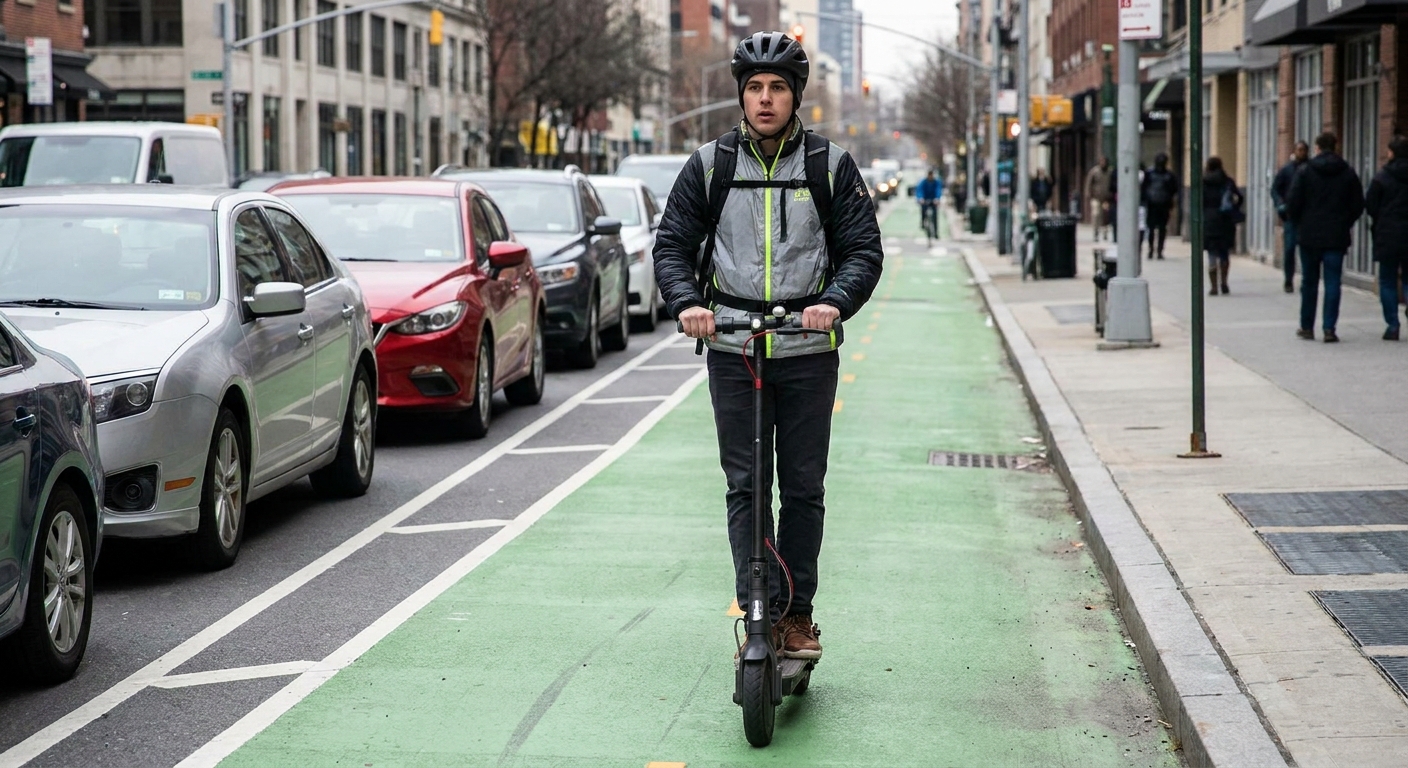
Utilizing dedicated bike lanes significantly improves electric scooter safety in city traffic by separating you from high-speed motor vehicles. Painted pathways and physical barriers create a dedicated zone where micro-mobility riders can travel without fear of rear-end crashes. When these lanes are missing, you must share the main road by staying close to the right curb. Choosing the correct lane prevents dangerous conflicts with cars and heavy trucks.

Riding Inside Protected Bike Lanes
Protected bike lanes are the absolute safest place for your e-scooter commuter runs. Physical structures like plastic posts or concrete curbs block cars from entering your riding zone.
But wait, there is more:
These lanes let you maintain a steady speed without stopping for gridlock.
- Stick to the center of the bike lane.
- Watch for cyclists overtaking you from behind.
- Slow down near bike lane intersections.
When dedicated lanes are unavailable, you must integrate into standard traffic flow predictably. Ride on the right side of the outermost lane and avoid weaving erratically between lanes.
But that is not all:
Cars need to see you holding a steady, predictable straight line.
- Stay within three feet of the right curb.
- Never weave between parked vehicles.
- Use hand signals before making a lane shift.
Key Takeaway: Strategic lane selection minimizes your interaction with heavy cars and establishes a clear, predictable path of travel.
| Lane Type | Safety Rating | Best Practice |
|---|---|---|
| Protected Path | Excellent | Maintain steady pace, watch cyclists |
| Shared Street | Moderate | Stay right, use clear hand signals |
| Pedestrian Sidewalk | Dangerous | Avoid entirely, walk your scooter |
Always seek routes with dedicated cycling infrastructure to reduce your overall traffic exposure.
How do intersections risk electric scooter safety in city traffic?
Intersections pose the highest risk to electric scooter safety in city traffic because crossing vehicle paths create frequent opportunities for blind-spot collisions. Most urban scooter accidents happen when cars turn across the path of a straight-moving rider. Distracted drivers often fail to spot smaller scooters when waiting to turn at crosswalks. Navigating these zones safely requires extreme alertness and active defensive tactics.

Avoiding the Right-Hook Collision
A “right-hook” happens when a car overtakes you and then turns right directly across your front wheel. You must anticipate this move whenever you approach a street corner alongside cars.
Here is the catch:
Drivers rarely check their passenger side mirror before executing quick turns.
- Never linger in a car’s right-rear blind spot.
- Slow down as you approach any intersection.
- Wait behind cars instead of pulling up beside them.
Making Eye Contact with Drivers
Never assume a driver sees you just because you have the green light. Always look directly at the driver of any waiting car to confirm they are looking at you.
Think about it:
If they are looking left for oncoming cars, they will not see you on their right.
- Make direct eye contact before crossing lanes.
- Watch the front tires of vehicles for movement cues.
- Keep your hands hovering over your brake levers.
Key Takeaway: Treat every intersection as a high-risk zone by slowing down and verifying driver attention before crossing.
| Intersection Hazard | Cause | Prevention Action |
|---|---|---|
| Right Hook | Turning cars crossing bike lanes | Ride behind turning vehicles |
| Left Turn | Oncoming cars turning across you | Slow down and verify driver gaze |
| Pedestrian Crossing | Heavy foot traffic swarming path | Yield fully and lower speed |
Visible cues like wheel direction and driver eye contact are more reliable than street signals.
What mistakes break electric scooter safety in city traffic?
Avoiding critical operator mistakes is essential to maintain electric scooter safety in city traffic and prevent costly legal fines or painful physical injuries. Many new riders pick up bad habits that compromise their control over the vehicle. Minor distractions can lead to catastrophic falls when you are sharing the asphalt with multi-ton cars. Recognizing and fixing these mistakes keeps your daily commute stress-free and safe.

The Danger of Riding with Headphones
Blocking out your hearing with music or podcasts removes a vital sensory channel needed to spot road dangers. You need your ears to hear sirens, car horn warnings, and approaching bicycles.
Look at this:
Your ears often detect a fast vehicle before your eyes can see it.
- Keep both ears completely free of earbuds.
- Use a handlebar-mounted speaker at low volume if needed.
- Stay alert to ambient city traffic noises.
Why Tandem Riding Leads to Falls
E-scooter frames, brakes, and suspensions are designed to carry exactly one person. Adding a passenger completely shifts the center of gravity and severely limits your steering control.
But wait, there is more:
Braking distances double when you overload the scooter deck.
- Never allow a second person on your deck.
- Walk your scooter if a friend needs a ride.
- Respect the manufacturer’s maximum weight limit.
Key Takeaway: Eliminating simple behavioral mistakes prevents control loss and keeps you legally compliant with local municipal codes.
| Riding Mistake | Risk Factor | Physical Result |
|---|---|---|
| Wearing Earbuds | High | Inability to hear warning horns |
| Tandem Riding | Extreme | Severe steering wobble and crashes |
| One-Handed Grip | High | Instant fall over small road bumps |
Maintaining dual-hand handlebar grip and clear hearing ensures optimal control.
Does night riding threaten electric scooter safety in city traffic?
Riding after dark threatens electric scooter safety in city traffic by reducing road visibility and making it harder for cars to spot your position. Distracted drivers struggle to see small, low-profile scooters against dark asphalt and bright city headlights. Potholes and road debris also become invisible traps without a high-powered lighting system. Extra caution and bright illumination are required to navigate the night safely.

Equipping Your Scooter with Dual Lights
Standard, low-mounted scooter headlights are rarely bright enough to illuminate dark roads. You should install a high-mounted headlight and a bright, flashing red taillight.
Here is the kicker:
Being visible from three hundred feet away gives drivers time to react.
- Use a headlight with at least 500 lumens.
- Set your taillight to flashing mode.
- Clean your light lenses regularly of road grime.
At night, small road imperfections like potholes, sewer grates, and gravel patches become serious crash hazards. You must scan the road closely and slow down to avoid losing traction.
Keep in mind:
Hitting a deep pothole at 15 mph can throw you over the handlebars.
- Reduce your night speed by at least 30 percent.
- Stick exclusively to well-lit main corridors.
- Ride with knees bent to absorb unexpected bumps.
Key Takeaway: Active, bright illumination and slower night speeds compensate for the loss of natural ambient road visibility.
| Light Type | Minimum Lumens | Visibility Range |
|---|---|---|
| Front Headlight | 500 Lumens | 100 feet path illumination |
| Rear Taillight | Flashing LED | 500 feet driver warning |
| Side Reflectors | Passive | 200 feet cross-traffic alert |
Never ride at night without verifying that both active lights are fully charged.

Start Riding Safely Today
Riding through the city does not have to feel like a high-stakes gamble. By wearing the right gear, respecting local laws, and staying highly visible, you can bypass the stress of traffic and enjoy a seamless, secure commute.
At Dynamic Scooter, we believe that urban mobility should be both thrilling and completely secure. That is why we engineer high-quality commuter models designed with safety first. Our outstanding entry model, the Dynamic Scooter Model B, offers riders dual drum brakes, a robust deck, and unmatched balance mechanics for just $392.17. Let us help you elevate your ride with professional engineering built to conquer city streets. If you have any questions about choosing the best riding setup or maintaining your safety gear, contact us today to speak with our dedicated support team!
Frequently Asked Questions
Can I ride my electric scooter on city sidewalks?
No, you cannot. Most major municipalities legally restrict electric scooters to streets and bike lanes to protect pedestrians from high-speed collisions.
What is the best helmet style for urban commuting?
A certified commuter helmet is the best choice. Look for models with MIPS technology or CPSC certification to ensure adequate protection against high-impact falls.
How do I know if my scooter headlight is bright enough for night riding?
You can verify this by checking its visibility from three hundred feet away. A headlight with at least 500 lumens is recommended to illuminate road obstacles safely.
Can I carry a passenger on my electric scooter?
No, you should never carry a passenger. Doing so shifts your center of gravity, overloads the brakes, and severely degrades your steering control.
How do I know if my tire pressure is safe for wet city streets?
You can know by checking the PSI levels weekly. Keeping your tires at the manufacturer’s recommended pressure ensures optimal traction and prevents slipping.