
Tired of getting dropped on climbs while your friends fly past? You miss out on epic trails because the uphill grind takes too long. Electric mountain bikes change the game with motor power that keeps you moving fast.
Electric mountain bikes typically reach speeds of 20-28 mph depending on their class and motor power. Class 1 and 2 models are limited to 20 mph, while Class 3 bikes can hit 28 mph with pedal assist. Actual speed depends on motor wattage, battery voltage, terrain, rider weight, and local regulations. Most e-MTBs use 250W to 1000W motors that provide strong assistance on climbs and flat trails.
Want to know exactly how fast you can go? Keep reading.
1. What Determines the Top Speed of an Electric Mountain Bike?
The top speed of an electric mountain bike depends on several key factors. Motor wattage is the most important. A more powerful motor can push you faster. Most electric mountain bikes use motors between 250W and 1000W. Higher wattage means more speed and better climbing power.
Battery voltage also plays a big role. A 48V system, like the one found on the Dynamic Scooter Electric Mountain Bike Q5, delivers more power than a 36V battery. This extra voltage helps the motor reach higher speeds. Here’s why it matters: voltage and wattage work together to give you the speed you need on the trail.
Legal speed limits are another factor. Most countries have laws that cap e-bike speeds. In the US, most e-MTBs are limited to 20 or 28 mph. In Europe, the limit is usually 15.5 mph for pedal-assist bikes. These limits are built into the bike’s controller.
Terrain and riding conditions affect your actual speed. Steep climbs slow you down, even with a powerful motor. Rough trails with rocks and roots also reduce speed. Wind resistance becomes a factor at higher speeds. Flat, smooth trails let you reach top speed more easily.
| Factor | Impact on Speed |
| Motor Wattage | Higher wattage = faster top speed |
| Battery Voltage | Higher voltage = more power delivery |
| Legal Limits | Caps maximum assisted speed |
| Terrain | Steep or rough trails reduce speed |
Your riding style and weight also matter. A heavier rider needs more power to reach the same speed. Pedaling hard with the motor gives you more speed than using throttle alone. The bike’s gearing and tire size also affect how fast you can go.
| Speed Range | Typical Scenario | Motor Assist |
| 0-10 mph | Technical trails, tight turns | Low to medium |
| 10-20 mph | General trail riding | Medium to high |
| 20-28 mph | Flat terrain, open trails | Maximum assist |

2. What Are the Legal Speed Limits for E-MTBs?
E-bikes are grouped into three main classes in the US. Class 1 e-bikes have pedal assist only and are limited to 20 mph. Class 2 e-bikes have a throttle and are also limited to 20 mph. Class 3 e-bikes have pedal assist up to 28 mph and no throttle.
The best part? Class 1 e-bikes have the most trail access. Many parks and trails that ban Class 2 and 3 e-bikes still allow Class 1 models. This makes them popular for mountain biking. Class 3 bikes are often restricted to roads and bike paths.
State laws can vary. Some states have their own rules about where you can ride each class. California, Colorado, and Utah have clear e-bike laws. Other states are still working on regulations. Always check local rules before you ride.
In Europe, the rules are different. Most countries follow EU regulations. E-bikes are limited to 250W motors and 15.5 mph (25 km/h) with pedal assist. Bikes that go faster are classified as mopeds and need registration and insurance.
| Region | Speed Limit | Motor Limit |
| US Class 1 & 2 | 20 mph | 750W typical |
| US Class 3 | 28 mph | 750W typical |
| European Union | 15.5 mph | 250W max |

Trail access rules are important. Many mountain bike trails now allow Class 1 e-bikes. Some trails ban all e-bikes. Others allow e-bikes only on certain days. Land managers are still figuring out the best policies. Respect posted signs and local regulations to keep trails open for everyone.
3. How Fast Can Different E-MTB Motors Go?
A 250W motor is common in Europe. These motors are limited to 15.5 mph by law. They provide good assistance on climbs but feel less powerful on flat ground. They are efficient and give you long battery life. Now, you might be wondering if 250W is enough for serious trails. For most riders, it works well on moderate terrain.
A 500W motor is popular in the US. It can reach 20 mph with pedal assist. This motor size gives you strong climbing power and good speed on flat trails. It is a good balance between power and battery life. Many mid-range e-MTBs use 500W motors.
A 750W motor is a powerful option, often the legal maximum in many US states for Class 3 bikes. For example, the Dynamic Scooter Electric Mountain Bike Q5 uses a high-speed 650W brushless motor that peaks at 1000W, allowing it to reach speeds up to 30 mph and handle steep climbs with ease. It gives you plenty of power for technical trails. Battery drain is higher, but the performance is worth it for aggressive riding.
A 1000W motor is very powerful. Some brands offer these for off-road use only. They can reach 30-35 mph on flat ground. These motors are often limited to 28 mph for legal reasons. They excel on extreme terrain and long climbs. Battery life is shorter due to high power draw.
| Motor Power | Typical Top Speed | Best Use |
| 250W | 15.5 mph | EU trails, efficiency |
| 500W | 20 mph | General trail riding |
| 750W | 28 mph | Aggressive riding, climbs |
| 1000W | 30+ mph | Extreme terrain, off-road |
Peak power is different from sustained power. A motor might have a peak rating of 1000W but run at 750W most of the time. Peak power helps with short bursts on steep climbs. Sustained power is what you get during normal riding. Both numbers matter for understanding real-world performance.
4. What Factors Affect Your Real-World E-MTB Speed?
Rider weight is a big factor. A heavier rider needs more power to reach the same speed as a lighter rider. If you weigh 200 pounds, you will go slower uphill than someone who weighs 150 pounds. The motor has to work harder to move more weight.
Your fitness level also matters. Let me explain: even with a motor, pedaling hard makes you faster. The motor amplifies your effort. If you pedal with more force, the bike goes faster. Lazy pedaling gives you less speed, even with full assist.
Trail grade changes everything. On a steep 15% climb, even a powerful electric mountain bike might only go 8-10 mph. On flat ground, the same bike can hit 28 mph. Downhill, you can go even faster, but the motor usually cuts off at the speed limit. Gravity does the work on descents.
Surface conditions slow you down. Loose dirt, mud, and rocks create drag. Smooth, hard-packed trails let you go faster. Wet conditions reduce traction and speed. Technical sections with tight turns also limit how fast you can safely ride.
| Factor | Effect on Speed |
| Rider Weight | Heavier = slower climbs |
| Fitness Level | More pedaling = more speed |
| Trail Grade | Steep climbs reduce speed |
| Surface Type | Rough terrain slows you down |
Wind resistance becomes noticeable above 20 mph. A strong headwind can reduce your speed by 3-5 mph. A tailwind gives you a boost. Your riding position also affects aerodynamics. Sitting upright creates more drag than leaning forward.
Tire type and pressure matter too. Knobby tires grip well but create more rolling resistance. Smoother tires roll faster on hard surfaces. Lower tire pressure gives better traction but slows you down. Higher pressure is faster but less comfortable on rough trails.
5. How Does Pedal Assist Impact Your Speed?
Pedal assist systems (PAS) have multiple levels. Most e-MTBs offer 3-5 assist levels. Level 1 gives light assistance. Level 5 gives maximum power. You can adjust the level based on terrain and how much help you want. Higher levels give more speed but drain the battery faster.
This is important because you can control your speed and range. On flat trails, use a lower assist level to save battery. On climbs, crank it up to level 5 for maximum speed and power. This flexibility is one of the best features of pedal assist.
Throttle-only mode lets you ride without pedaling. You twist or press the throttle, and the motor does all the work. This is great for starting from a stop or taking a break on long rides. However, throttle mode drains the battery much faster than pedal assist.
Cadence sensors detect when you are pedaling. They turn on the motor as soon as you pedal. The assist level stays constant regardless of how hard you pedal. Torque sensors are more advanced. They measure how hard you are pedaling and adjust motor power accordingly. Torque sensors feel more natural and responsive.
| Sensor Type | How It Works | Riding Feel |
| Cadence Sensor | Detects pedaling motion | Consistent assist |
| Torque Sensor | Measures pedal force | Natural, responsive |
Balancing speed with battery range is key. Riding at top speed all the time will drain your battery quickly. For instance, a bike like the Electric Mountain Bike Q5 with its 48V 13Ah battery can offer up to 60 miles in pedal-assist mode, but that range will decrease if you consistently ride at its top speed. Using moderate assist levels can give you 40-60 miles of range. Think about your ride distance and adjust your assist level to match. You can always increase power when you need it.
6. Can You Make Your E-MTB Go Faster?
Upgrading your motor and controller can increase speed. Some aftermarket controllers remove speed limits. A more powerful motor can also boost top speed. But here’s the thing: these modifications often void your warranty. They can also make your bike illegal for trail use.
Battery voltage modifications are another option. Swapping a 36V battery for a 48V battery gives you more power and speed. This requires a compatible motor and controller. Higher voltage can strain components and reduce their lifespan. It is a risky modification that can damage your bike.
Removing speed limiters is tempting but dangerous. Many e-bikes have software limits that cap speed at 20 or 28 mph. Some people hack the controller to remove these limits. This makes your bike illegal in most places. You can lose trail access and face fines. It is not worth the risk.
Performance tuning includes smaller changes. You can adjust tire pressure for less rolling resistance. Lighter wheels and tires can improve acceleration. Upgrading to a more efficient drivetrain helps too. These changes give small speed gains without legal issues.
| Modification | Speed Gain | Risks |
| Controller Upgrade | 5-10 mph | Voids warranty, illegal |
| Voltage Increase | 3-7 mph | Component damage |
| Speed Limiter Removal | 10+ mph | Loss of trail access |
| Tire/Wheel Upgrade | 1-3 mph | Minimal risk |
The legal and safety concerns are serious. Modified e-bikes are banned from most trails. If you get caught, you could be fined or banned from the trail system. Modified bikes are also more dangerous. Higher speeds increase the risk of crashes and injuries. Stick with legal modifications or buy a more powerful bike from the start.
7. How Does E-MTB Speed Compare to Regular Mountain Bikes?
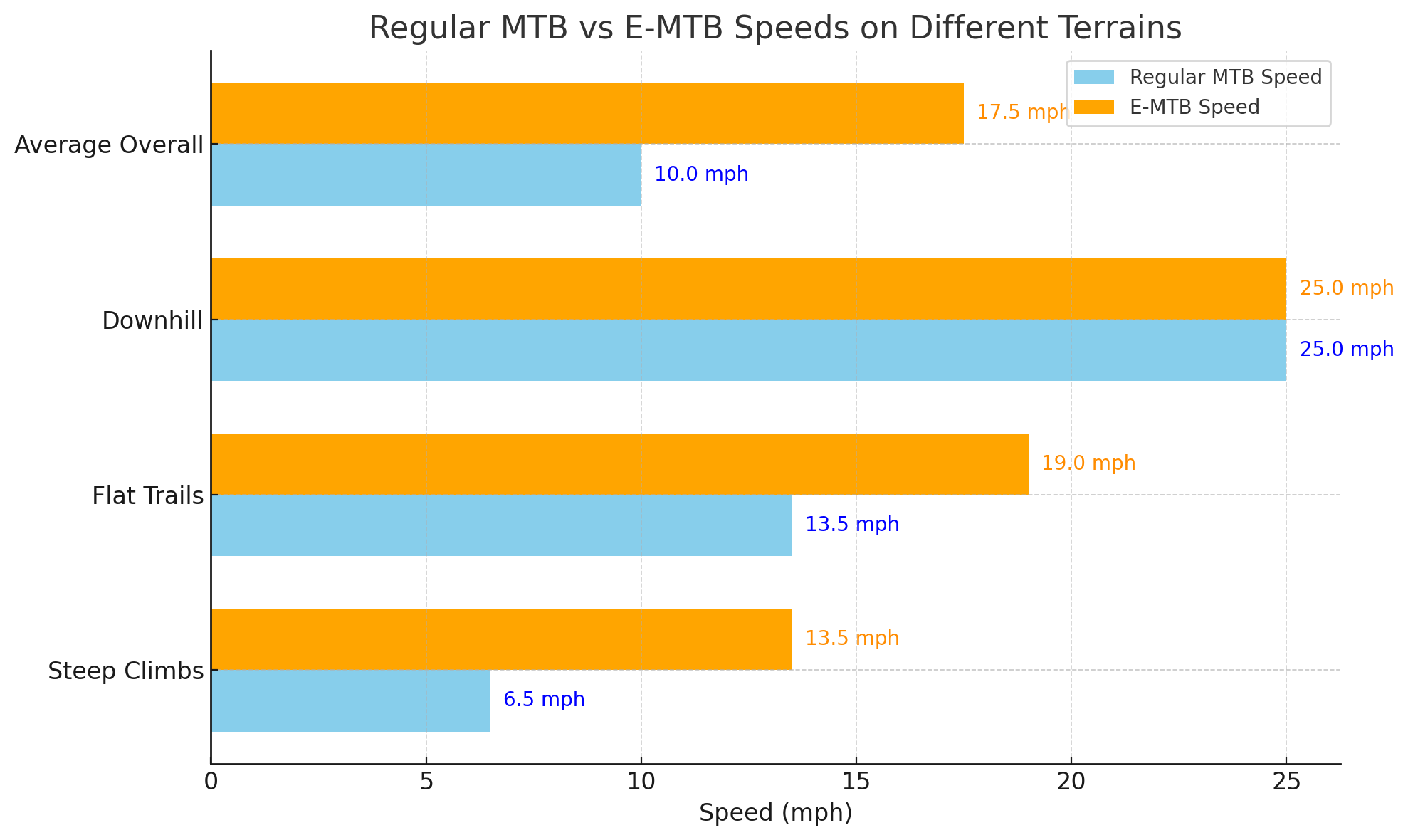
On climbs, electric mountain bikes are much faster. A regular mountain bike might average 5-8 mph on a steep climb. An electric mountain bike can maintain 12-15 mph on the same climb with moderate effort. The bottom line? You get to the top faster and with more energy left for the descent.
On flat terrain, electric mountain bikes also have an advantage. A performance model like the Dynamic Scooter Q5 can easily cruise at 20 mph or more, while a fit rider on a regular bike might average 12-15 mph. An electric mountain bike can cruise at 18-20 mph with less effort. This lets you cover more distance in the same amount of time.
Downhill speed is similar for both bikes. The motor cuts off above the speed limit, so you are coasting on gravity alone. A regular mountain bike and an electric mountain bike will go about the same speed downhill. The extra weight of the e-MTB can actually help you carry more speed through rough sections.
Overall ride time is much shorter on an electric mountain bike. A 20-mile trail loop that takes 2.5 hours on a regular bike might only take 1.5 hours on an e-MTB. You spend less time grinding up climbs and more time enjoying the ride. This is a huge benefit for riders with limited time.
| Terrain Type | Regular MTB Speed | E-MTB Speed |
| Steep Climbs | 5-8 mph | 12-15 mph |
| Flat Trails | 12-15 mph | 18-20 mph |
| Downhill | 20-30 mph | 20-30 mph |
| Average Overall | 8-12 mph | 15-20 mph |
Electric mountain bikes let you ride longer and farther. You can tackle trails that would be too hard on a regular bike. You can ride with faster friends and keep up. The speed advantage makes mountain biking more accessible and more fun for riders of all fitness levels.
Conclusion
Electric mountain bikes offer speed that transforms your riding. Most e-MTBs reach 20-28 mph depending on their class and motor power. Legal limits, terrain, and rider weight all affect real-world speed. Pedal assist gives you control over speed and battery life. While modifications can increase speed, they come with legal and safety risks. Compared to regular mountain bikes, e-MTBs are much faster on climbs and flat terrain, cutting ride times and opening up new trails. You get more distance, more fun, and more confidence on every ride.
Ready to experience the speed and power of an e-MTB? Dynamic Scooter Electric Mountain Bike Q5 offers high-performance electric mountain bikes with powerful motors and long-range batteries. Contact us today to find the perfect e-MTB for your riding style and start riding faster.

FAQ
Q1: What is the average top speed of an electric mountain bike?
Most e-MTBs reach 20-28 mph depending on their class. Class 1 and 2 e-bikes are limited to 20 mph, while Class 3 models can hit 28 mph. Motor power, terrain, and rider weight affect actual speed.
Q2: Are electric mountain bikes faster than regular bikes?
On climbs and flat terrain, e-MTBs are much faster due to motor assistance. A regular mountain bike averages 8-12 mph on trails, while an e-MTB can maintain 15-20 mph with less effort.
Q3: Is it legal to modify an e-MTB to go faster?
Modifying your e-MTB to exceed legal speed limits can void warranties, violate local laws, and restrict trail access. Many areas ban modified e-bikes from public trails and bike paths.
Q4: How fast can a 1000W electric mountain bike go?
A 1000W e-MTB can reach 30-35 mph on flat ground with full throttle. However, most are electronically limited to 28 mph for legal compliance. Actual speed depends on battery voltage and terrain.
Q5: Does higher speed drain the battery faster on an e-MTB?
Yes, riding at top speed drains the battery much faster. At 28 mph, you might get 15-25 miles of range. At 15 mph with moderate assist, range can extend to 40-60 miles.