Understanding Regenerative Braking in Electric Scooters
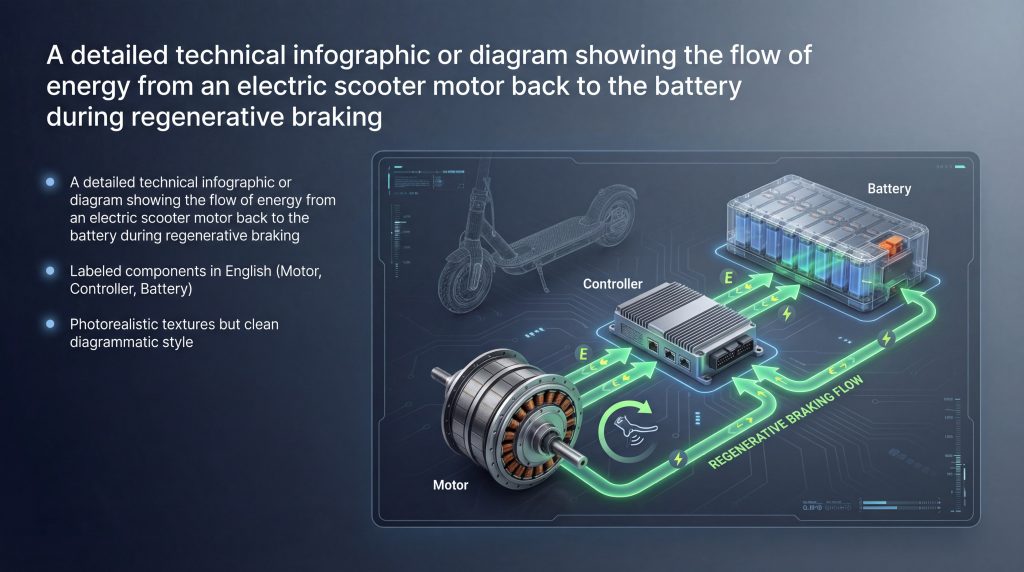
Regenerative braking is an energy recovery mechanism that slows a vehicle by converting its kinetic energy into a form that can be either used immediately or stored in a battery. If you are a daily commuter, you likely struggle with range anxiety and the constant need to find a charging outlet. Standard friction brakes waste massive amounts of energy as heat, effectively throwing away the momentum you worked so hard to build. By utilizing regenerative braking in electric scooter technology, you can recapture that lost energy and turn every stop into a mini-charge for your ride. 1. What Is Regenerative Braking in Electric Scooters? Regenerative braking in electric scooters refers to the process where the electric motor acts as a generator to recharge the battery during deceleration. This system captures the kinetic energy of your moving scooter and directs it back into the power cell rather than letting it dissipate. Integrating regenerative braking in electric scooter models represents a major leap in personal transport efficiency. It ensures that your hardware works for you even when you are slowing down. The Transition From Mechanical to Electronic Braking The shift toward electronic braking systems marks a significant evolution in how you control your speed on the road. Traditional systems rely solely on friction, but modern scooters use magnets to create drag. Here is the deal: switching to electronic braking doesn’t just save energy; it changes the entire feel of your ride. The Evolution of Energy Recovery in Personal EVs Personal electric vehicles have come a long way from simple motorized frames to high-tech commuting tools. Energy recovery used to be reserved for high-end electric cars, but it is now accessible for your daily commute. But that’s not all. This evolution means you get a smarter, more responsive vehicle that understands how to manage its own power reserves. Key Takeaways: Feature Mechanical Braking Regenerative Braking Primary Method Physical Friction Electromagnetic Induction Energy Impact Lost as Heat Recovered to Battery Components Pads, Discs, Cables Motor, Controller, Battery Analysis: While mechanical brakes provide raw stopping power, regenerative systems offer a sustainable way to manage momentum and energy efficiency. 2. How Does the Motor Generate Electricity While Braking? The motor generates electricity by utilizing electromagnetic induction to convert the spinning motion of the wheels back into electrical current. When you stop applying power, the wheel continues to spin the motor’s internal components through magnetic fields. This creates a flow of electrons that the controller directs back to your power supply. Implementing regenerative braking in electric scooter designs relies on this fundamental principle of physics. Understanding the Dual Role of Brushless DC Motors Your scooter’s brushless DC (BLDC) motor is a versatile piece of engineering that works in two directions. In drive mode, it consumes electricity to move you; in braking mode, it produces it. Think about it: your motor is essentially a power plant that you carry between your wheels. The Science of Stators, Rotors, and Magnetic Fields The interaction between the stationary part of the motor (stator) and the rotating part (rotor) is where the magic happens. As the rotor spins past the stator’s coils, it “pushes” electrons through the wire. But wait, there’s more. The strength of this magnetic field can be adjusted by the controller to provide more or less braking force. Key Takeaways: Component Function During Propulsion Function During Braking Battery Supplies electrical energy Receives recovered energy Controller Directs power to the motor Routes current to the battery Motor (BLDC) Converts electricity to motion Acts as a generator Analysis: The seamless transition between consuming and generating power is the technical foundation that allows for extended range and smoother deceleration. 3. What Happens When You Engage the Regenerative Brake? Engaging the brake sends a digital signal to the controller to reverse the phase of the motor, creating resistance that slows the scooter. This happens the moment you pull the lever or release the throttle, depending on your scooter’s settings. The motor effectively becomes a “drag” on the wheel, converting your forward speed into electrical energy. Understanding the activation of regenerative braking in electric scooter systems helps you anticipate how your vehicle will respond. Converting Kinetic Energy into Battery Power As you slow down, the energy of your movement has to go somewhere. Instead of wearing down your brake pads, that energy travels through the wires back to your battery pack. You might be wondering: does this happen every time I slow down? In most modern configurations, yes, the system is designed to be as proactive as possible. Creating Motor Resistance to Slow Your Momentum The resistance you feel when the electronic brake is active is the result of the motor fighting against its own magnets. This force provides a smooth, predictable deceleration that feels different from a mechanical “bite.” Here’s the kicker: this resistance is entirely frictionless, meaning there are no parts rubbing together to wear out. Key Takeaways: Step Action Outcome 1 Release throttle or pull lever Signal sent to the controller 2 Power supply cut Motor ceases propulsion mode 3 Induction begins Spinning wheel generates current 4 Energy storage Current is sent to the battery Analysis: By translating motion into magnetism, the system creates a controlled deceleration that benefits both the rider’s control and the vehicle’s battery life. 4. Can It Actually Increase Your Scooter’s Travel Range? Regenerative braking can increase your travel range by reclaiming energy that would otherwise be lost as heat through mechanical friction. While it won’t give you an infinite ride, it can add precious percentage points back to your battery during a long commute. This is especially true if your route involves many hills or frequent stop-and-go traffic. Optimizing regenerative braking in electric scooter use is one of the easiest ways to get more miles out of a single charge. Managing Expectations for Energy Recovery Efficiency It is important to understand that no system is 100% efficient due to the laws of thermodynamics. You will only recover a fraction of the total energy used to […]
Understanding Regenerative Braking in Electric Scooters Read More »