
How Much Electricity Does an Electric Scooter Use?
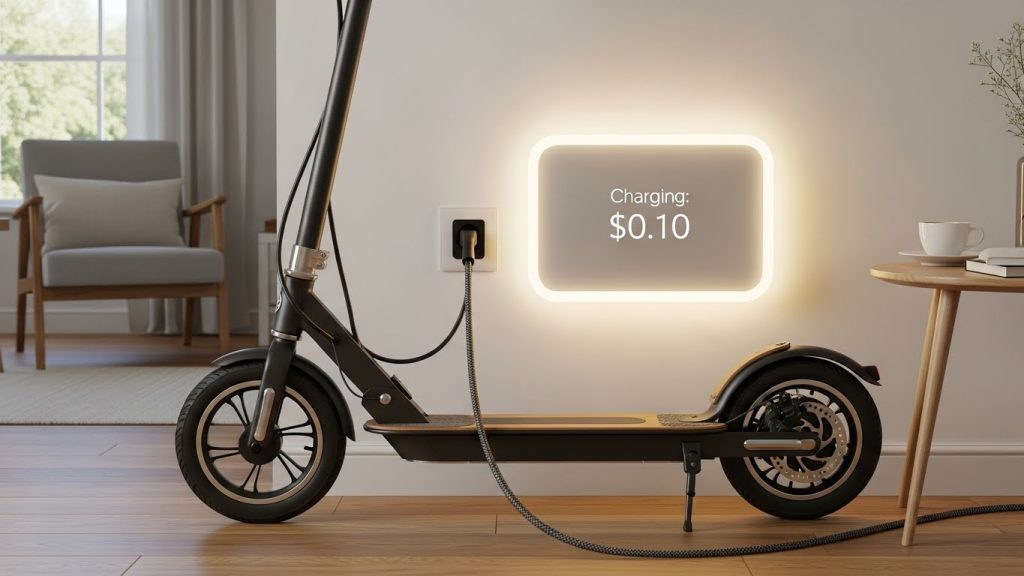
Electric scooters are praised for being a green and cost-effective way to travel, but how much electricity do they actually consume? You might worry that charging your scooter every day will lead to a surprisingly high electricity bill, negating the savings you were hoping for. It can be confusing to see numbers like volts, amp-hours, and watts and not know what they mean for your wallet. You might even wonder if your eco-friendly choice is secretly an energy hog, contributing more to your carbon footprint than you realize. This uncertainty can make it hard to fully embrace the benefits of electric micro-mobility. An electric scooter uses a very small amount of electricity, typically between 0.3 and 0.6 kilowatt-hours (kWh) for a full charge, which usually costs just a few cents. This makes them one of the most energy-efficient modes of powered transportation available, far more economical and environmentally friendly than cars or even public transit. So, how is this calculated, and what does it mean in the real world? Here’s the deal… This article will demystify the numbers, compare the energy use of e-scooters to other vehicles, and show you exactly how much you can expect to pay to power your ride. 1. How is an electric scooter’s electricity usage measured? To understand how much electricity your scooter uses, you first need to get familiar with a few key terms. The most important unit of measurement is the kilowatt-hour (kWh). This is the standard unit that your utility company uses to bill you for electricity. One kWh is the amount of energy you would use if you ran a 1,000-watt appliance for one hour. For electric scooters, the battery capacity is usually given in Watt-hours (Wh) or amp-hours (Ah) and volts (V). To find the total energy your battery can hold in Watt-hours, you simply multiply the amp-hours by the volts. For example, a battery rated at 10 Ah and 36V has a capacity of 360 Wh (10 Ah * 36V). To convert this to kilowatt-hours, you just divide by 1,000. So, a 360 Wh battery is equivalent to 0.36 kWh. This is important because… this number is the foundation for calculating your charging costs. When you charge your scooter, the process isn’t 100% efficient; some energy is lost as heat. This means that to put 0.36 kWh of energy into your battery, you might need to draw around 0.4 kWh from the wall outlet. This small difference is important for precise calculations but doesn’t change the overall picture: scooters use a tiny fraction of the electricity of larger appliances or vehicles. Electrical Term Definition Relevance to E-Scooters Kilowatt-hour (kWh) Energy consumed by a 1,000W appliance in one hour The unit used to measure and bill for electricity consumption. Watt-hour (Wh) A unit of energy equal to one watt of power sustained for one hour The most common measure of an e-scooter battery’s capacity. Amp-hour (Ah) A unit of electric charge, indicating battery capacity Multiplied by volts to determine the battery’s Watt-hour capacity. 2. What factors determine an e-scooter’s electricity consumption? The amount of electricity your scooter consumes on a given ride isn’t a fixed number. It’s influenced by a variety of factors. One of the biggest factors is the rider’s weight. A heavier rider requires the motor to work harder and draw more power to maintain the same speed as a lighter rider, which directly leads to higher energy consumption per mile. The terrain you ride on also plays a huge role. Riding up hills is a major power drain, as the motor has to fight against gravity. Your riding style is another critical element. Aggressive acceleration and constant stop-and-go riding use far more energy than maintaining a smooth, steady speed. Finally, basic maintenance can have a surprising impact. The bottom line? Properly inflated tires have less rolling resistance, which means the motor doesn’t have to work as hard. A well-lubricated chain and clean components also contribute to better efficiency. All these factors combined determine the real-world range and electricity usage of your scooter. Factor Impact on Electricity Use How to Optimize for Efficiency Rider Weight Heavier weight increases consumption Reduce unnecessary cargo. Terrain Hills significantly increase consumption Choose flatter routes when possible. Riding Style Aggressive riding uses more power Accelerate smoothly and maintain a steady speed. 3. How much does it cost to fully charge an electric scooter? One of the most attractive features of an electric scooter is its incredibly low running cost. To figure this out, you need two pieces of information: the capacity of your scooter’s battery in kWh and the price your utility company charges for electricity per kWh. The average price of electricity in the United States is around 16 cents per kWh. Let’s take a typical electric scooter with a 360 Wh (or 0.36 kWh) battery as an example. To calculate the cost of a full charge, you simply multiply the battery capacity by the electricity rate. So, 0.36 kWh multiplied by $0.16/kWh equals just under 6 cents. Want to know the secret? That’s right, a full charge that can take you 15-20 miles costs less than a dime. Even with a larger battery, say 600 Wh (0.6 kWh), the cost is still only about 10 cents. When you compare this to the cost of other forms of transportation, the savings are staggering. A single gallon of gasoline can cost 30 to 50 times more than a full scooter charge. A bus ticket for a single trip is often several dollars. This makes electric scooters one of the most economical ways to travel. Vehicle Energy Cost for a 20-Mile Trip Notes Electric Scooter ~$0.06 Based on a 360 Wh battery and $0.16/kWh. Gasoline Car (30 MPG) ~$2.33 Based on $3.50/gallon gasoline. Public Bus ~$2.50 Based on a typical single-fare ticket. 4. How does an e-scooter’s energy use compare to other vehicles? Electric scooters are champions of energy efficiency. When you compare the amount of energy it takes to move a person […]
How Much Electricity Does an Electric Scooter Use? Read More »